Wealthsimple ran Super Bowl ads in Canada for the fifth time in 2021, at a far lower cost per viewer than in the US.
Its ads put real people and then famous faces such as Martin Short on camera.
Clients grew from 10,000 in 2015 to 3.6 million by June 2026, per Wikipedia.
Wealthsimple is a Toronto investing app that grew from a spreadsheet into a company with millions of clients. This breakdown covers its first Super Bowl campaign, the maths behind buying the game in Canada, the product that made news on its own, its ads with real people and then celebrities, its magazine, the 2026 push into banking with Monthly Millionaire, and the rules for finance brands that work with creators.
What Wealthsimple is
Wealthsimple is an investing app from Canada. Wikipedia says The firm was founded in September 2014 by Michael Katchen, Brett Huneycutt, and Rudy Adler and is based in Toronto. As of November 5, 2025, the firm holds over C$170 billion in assets under administration.
It began with a spreadsheet. Before the company, Michael Katchen worked at a startup bought by Ancestry.com. Then Katchen developed a spreadsheet with tips to help his colleagues set up investment portfolios. Interest in the spreadsheet helped inspire the idea for Wealthsimple.
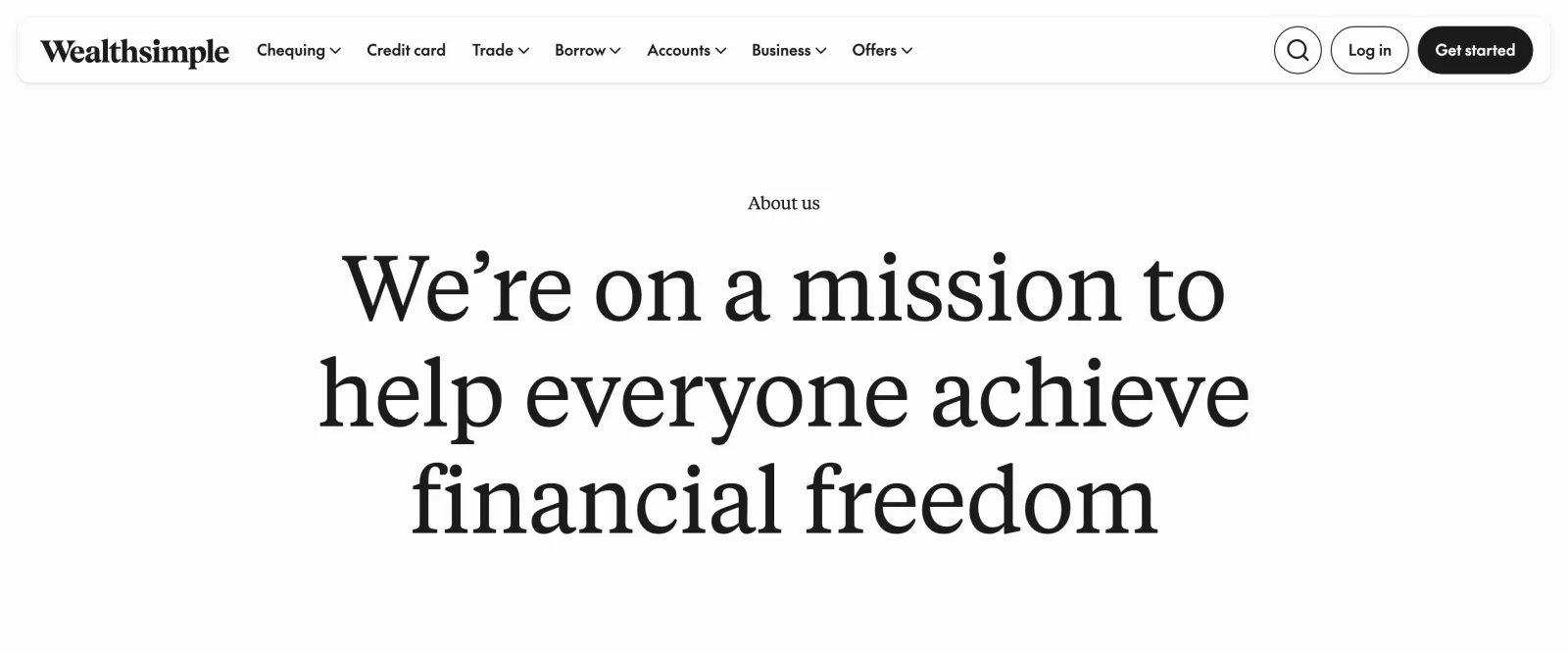
The company tells the same story on its about page: We started Wealthsimple because investing in Canada felt like you needed a Ph.D to understand it. Its mission line reads We’re on a mission to help everyone achieve financial freedom. And its pitch: In a complex industry, simplicity sets us apart.
Adweek sums up who came first: Founded in 2014, Wealthsimple was one of the first platforms to find market traction with young, high-earning investors looking for more tech-forward investment tools.
“The incentive helps get people in the door and the product experience keeps them there.”Paul Teshima, Wealthsimple, to Fintech.ca
The first campaign: the Super Bowl in 2016
Wealthsimple went big early. Media in Canada reported that, with a Super Bowl spot, With that move, Wealthsimple debuted a three-month campaign aimed at growing its clientele and building brand awareness.
The target was clear. The Toronto-based investment company is building its business around getting younger Canadians (aged 25 to 39) to set up accounts that it says will ensure them financial comfort as they age.
The company chose the Super Bowl to kick-off a three-month, multiplatform campaign that will run through April 2016. It ran under the line Take Care of Yourself.
The team kept the ideas close. The Wealthsimple team decided against investing in a creative agency and developed ad copy in-house. The spots were directed by Jun Diaz, edited by Saints Editorial and the sets for all four spots were developed by the set designer and cinematographer from Drake’s “Hotline Bling.” Wieden + Kennedy worked on media planning for the campaign.
Jason Goldlist, then the CMO, framed the brief as a question: “How do we get people interested in wise, dispassionate, optimized investing when they’re young and they still have time to do it painlessly?”
The game was only the launch. Media in Canada says the Super Bowl spot cost little next to the rest of the plan, which ended up being less than 10% of their total media spend, using the event as a launch pad for its campaign. In addition to airing during other live events (NBA All-Star Game, the Academy Awards, etc) the 30-second spots will also roll out in select theatres across Canada. Online, the spots will run as preroll on YouTube, Vice and Vox, as well as other sites. The campaign has a paid social component as well on Facebook, Twitter and Instagram.
Why the Super Bowl is cheap in Canada
Five years later the company explained the maths in its own magazine. That’s why we’re investing in Super Bowl ads for the fifth time.
The big point is cost. A Canadian spot, it said, costs about 95 per cent less than a US one. Yet more people watch: 51 per cent of the population here versus 45 per cent there. And the crowd is big. Last year’s Super Bowl drew a record average of 9.5 million Canadian viewers.
So the price per viewer drops. Our 30-second Super Bowl ad, assuming a similar viewership to last year, will cost at least 65 per cent less per thousand viewers than it would if we advertised in the U.S. Which means you get nearly three times as many viewers in Canada for every dollar spent.
That year the game launched a tax product. Which is why we figured the Super Bowl was a great way to launch our new ad campaign: “Anyone Can Do Their Taxes.” The magazine adds that we didn’t use a big expensive ad agency. We made them in-house.
The lesson for any brand: the biggest moment is not always the most expensive one. Look for the market where the same audience costs less.
- 01About 95% lessThe cost of a spot in Canada next to the US.
- 0251% vs 45%The share of people who watch, Canada vs the US.
- 039.5 millionThe record average Canadian audience the year before.
- 0465% lessAt least, per thousand viewers.
- 05Nearly 3xThe viewers per dollar spent in Canada.
- 06Made by its own teamNo big outside agency for the 2021 spots.
The product made its own news
Wealthsimple also won attention by building things first. In 2015, Product Hunt Toronto honoured Wealthsimple with its first-ever Product of the Year Award. In 2016, the 20th Annual Webby Awards named Wealthsimple its Best Financial Services/Banking website.
Then came trading. This platform was introduced in March 2019, offering a stock and ETF trading account with zero-commission fees in the U.S. and Canada. Wealthsimple Trade was the first commission-free trading platform in Canada.
Demand ran ahead of the systems. As of March 2020, Wealthsimple Trade became unable to handle the volume of trades their customers were placing and began capping the number of users and putting some investors on to waitlists. A waitlist is not a plan, but it tells you the product was pulling people in.
Fans with big names put money in. In May 2021, Wealthsimple announced a $750 million CAD financing round at a post-money valuation of $5 billion CAD, and other backers included celebrity investors including Drake, Michael J. Fox, and Ryan Reynolds.
The growth kept going. In October 2025, Wealthsimple raised $750 million CAD in a Series F round at a post-money valuation of $10 billion CAD. In October 2025, Michael Katchen announced that Wealthsimple had reached CA$100B in assets under administration 3 years ahead of schedule.
For how other trading apps grew on a free-trading pitch, see our Robinhood breakdown and our Webull breakdown.
Investing for Humans: real people on camera
In 2017 the ads turned to ordinary people. BNN Bloomberg reported: Dubbed “Investing for Humans,” the campaign includes a series of 30-second videos featuring mostly young people of diverse backgrounds speaking candidly about their personal relationships with money.
The audience was new to all this. Of its clients at the time, 40 per cent of whom are first-time investors.
Mike Giepert, the executive creative director, told BNN: “We thought it might make a really interesting campaign to put real people on camera and let them sort of open up about the way that money has shaped and affected their lives”
Not everyone agreed it worked. But marketing experts disagree about how well this campaign allows Wealthsimple to reach its audience. One agency head said he admires Wealthsimple’s product but he’s not a fan of this campaign. His view: “There’s no story, there’s no drama, there’s no reason for me to care.”
A marketing professor saw it the other way: “It’s singular people giving you a single message about them as opposed to facts and figures. That’s a really different kind of approach and it’s very compelling for millennials”
Both views hold a lesson. Real people build trust, but each clip still needs a story with a turn in it.
Famous faces: Martin Short and the lazy spokesperson
By 2023 the ads leaned on stars. Strategy reported: A new celebrity-centered ad campaign from Wealthsimple, playing off of the idea that Canadians’ money should be working for them, launched on Sunday, featuring Canadian actor Martin Short.
The joke is in the script. The spot features Short phoning in an ad spot for Wealthsimple, misreading the company’s “your money should work harder than you do” slogan. Adweek describes the spot: In the spot by agency Preacher, Short walks on to the set, flubs the one line he has, then is physically carried off by his assistant to a helicopter, which flies him roughly 50 yards to his car.
The timing was chosen. The campaign first aired during the Canadian Football League’s championship game, the Grey Cup, which was played on Sunday Nov. 19 in Short’s hometown of Hamilton, Ontario.
Short was not the first. It’s the latest ad from the online investment management service that features a celebrity, after past collaborations with Succession star Nicholas Braun, drag queen Tynomi Banks and WNBA player Skylar Diggins-Smith.
The campaign was led by CMO Rubina Singh, who joined Wealthsimple earlier this year. Rubina Singh explained the mood: “Canadians are working harder than ever and finding it ridiculous that earning a consistent, healthy paycheque isn’t enough to feel financially secure anymore,” On the casting: “When our team began thinking about who would be the right voice to represent this campaign, we knew we needed someone who would resonate with the wide breadth of Canadians we serve,” “And we wanted someone who could offer a bit of levity to those who may be feeling overwhelmed by their finances.”
- 01Martin ShortThe lazy spokesperson in the 2023 spot.
- 02Nicholas BraunAn earlier ad, per Strategy.
- 03Tynomi BanksAn earlier ad, per Strategy.
- 04Skylar Diggins-SmithAn earlier ad, per Strategy.
- 05Drake, Michael J. Fox, Ryan ReynoldsInvestors in the 2021 round, per Wikipedia.
- 06Awkwafina, Anthony BourdainSubjects of Money Diaries.
This one had outside help. Short and his team worked closely with Wealthsimple’s in-house creative team and advertising agency Preacher on the campaign’s concept and scripting. This marks the first campaign for Wealthsimple in almost two years, and the first in collaboration with an outside agency.
Zach Watkins, creative director at Preacher, told Adweek: “Instead of playing it on the nose and featuring people who work hard, it seemed more interesting to do the exact opposite. Cue Martin Short, who was gracious enough to help us create the world’s most obnoxiously lazy spokesperson.”
For how other finance brands use famous faces, see our Public.com breakdown and our Revolut breakdown.
A magazine as marketing
Wealthsimple also publishes. Its pages say Wealthsimple Magazine tells compelling, thoughtful, and unique stories about money through the lens of local, creative, and influential people.
The home page calls it A money magazine for people who care about more than money. It promises Conversations with geniuses and weirdos, help with investing and taxes, and stories that help you understand the big strange world we live in.
The best known series is Money Diaries. Its tagline is Telling the truth about money, one person's story at a time. The editors write: For the last five years, our “Money Diaries” series has been all about telling truths.
Stars come in here too, as subjects rather than spokespeople. Headlines include Awkwafina Tells Us the Money Secrets of Viral Fame and Anthony Bourdain Does Not Want to Owe Anybody Even a Single Dollar.
The other sections cover How to be a better money person and How money shapes the world we live in. Money Diaries itself promises Candid money stories from interesting people.
A magazine like this gives a finance app something to say every week that is not an ad. Each long interview also cuts into short clips. For how that works, read how to market a trading app.
- 01Money DiariesCandid money stories from interesting people.
- 02Finance for HumansHow to be a better money person.
- 03Money and the WorldHow money shapes the world we live in.
2026: banking fees and Monthly Millionaire
Wealthsimple now wants to be people’s bank. Fintech.ca described its It’s Over campaign as a campaign positioning Wealthsimple as an alternative to the traditional banking relationship.
Then came a print ad. Appearing in several of Canada’s largest national newspapers, the campaign offers a line-by-line accounting of the monthly charges, transaction limits, foreign exchange markups, ATM fees, overdraft costs, investment fees, and transfer penalties that can quietly erode Canadians’ savings. The new print campaign brings that argument down to dollars and cents.
Paul Teshima, its Chief Marketing and Commercial Officer, said: “We published this ad to make the hidden fees of Canadian banking, which are quietly eroding people’s savings, harder to ignore.” He says financial services come with a lot of fine print, and for this ad, we read through it and calculated the costs.
The shift shows up in the numbers. Fintech.ca reports that new chequing account openings surpassed investing accounts for the first time.
Next is a prize. In May 2026, Wealthsimple launched Monthly Millionaire, a recurring prize-linked savings promotion for clients. Clients earn 500 entries for opening a chequing account and one entry for each dollar of net deposits, with entries doubled for clients who set up direct deposit and 5,000 entries for each successful referral.
Teshima says: “Incentives such as Monthly Millionaire give people an extra reason to overcome the inertia of switching.” And: “The incentive helps get people in the door and the product experience keeps them there.”
He also names the hard part: “The biggest barrier is the difficulty of switching.” He says clients They also want financial services to be more fun and engaging.. His team’s answer: “We listen, ship new products and features fast, and are responsive to changes clients ask for.”
For other apps that moved from investing into banking, see our SoFi breakdown and our Chime breakdown.
The rules for finance brands that work with creators
Wealthsimple’s own ads are clearly ads. Creator posts are different, and Canada’s regulators are watching. The Ontario Securities Commission found: An OSC survey of 655 Canadian retail investors found that about 35% of respondents reported making a financial decision based on advice from a finfluencer.
Trust runs high. The OSC says about 40% of investors believe that the finfluencers they follow are trustworthy, and that those who have made a financial decision based on finfluencer advice were also 12 times more likely to have been scammed on social media.
Posts move money. Nearly 24% of participants exposed to finance-related social media posts purchased the promoted assets, compared to about 7% of those not exposed. Leslie Byberg of the OSC said: “Finfluencers have a clear capacity to affect their audience’s behaviour, and this influence could diminish retail investor well-being.”
In the US, the FTC tells creators: If you endorse a product through social media, your endorsement message should make it obvious when you have a relationship (“material connection”) with the brand. The rule itself says: When there exists a connection between the endorser and the seller of the advertised product that might materially affect the weight or credibility of the endorsement, and that connection is not reasonably expected by the audience, such connection must be disclosed clearly and conspicuously. Material connections can include a business, family, or personal relationship.
So a finance brand that pays creators should make sure every post names the deal. For the wider picture, read our finfluencer marketing rules, what a finfluencer is and our finfluencer statistics.
What any trading platform can copy
- 01Buy the cheap big momentThe same game cost far less per viewer in Canada.
- 02Use the launch as a launch padThe Super Bowl was under 10% of the 2016 media spend.
- 03Let the product make newsFree trades and a waitlist drew people in.
- 04Put real people on cameraThen give each clip a story with a turn.
- 05Publish, not just advertiseA magazine gives you something to say every week.
- 06Name every paid tieCreator posts about money need the deal in the post.
For the numbers behind the niche, read our retail trading statistics and how to market a fintech app. For other trading brands, see our Trading 212 breakdown, our Moomoo breakdown and our Wealthfront breakdown. For another commission-free app aimed at younger investors, see our Freetrade breakdown. For a platform whose ad shows a customer crashing a club for the rich on a giant bell, see our AJ Bell breakdown. For a broker that showed every cost before the first trade, see our Zerodha breakdown. For an investing app that ran six IPL films about personal growth, see our Groww breakdown. For an investing platform that started as a robo-advisor in 2016 and still runs managed portfolios, see our Scalable Capital breakdown. For a Canadian broker whose brand line is Tilt finance in your favour, see our Questrade breakdown. For an investing app that publishes 1,034 posts under one team byline, see our Stash breakdown. For an investing app whose mission page says what it will not do, see our M1 Finance breakdown. For an investing app that published its own magazine, see our Stake breakdown. For an investing app that published its own magazine, see our Sharesies breakdown.
We run creator content and posting for trading platforms on accounts you own, built for your compliance sign-off, with every post tracked for views, link clicks and click-through rate.
Frequently asked questions
Wikipedia calls Wealthsimple a Canadian online investment management service. It was founded in September 2014 by Michael Katchen, Brett Huneycutt and Rudy Adler and is based in Toronto. It offers investing, trading, chequing, crypto and tax filing.
Its magazine said a Super Bowl spot in Canada costs about 95 per cent less than in the US, while a larger share of the population watches. It worked out that a Canadian spot would cost at least 65 per cent less per thousand viewers.
Canadian actor Martin Short starred in a 2023 spot that first aired during the Grey Cup. He plays a lazy spokesperson who flubs his one line, to show that Wealthsimple works harder for your money. It was made with the agency Preacher.
Wikipedia says it is a recurring prize-linked savings promotion for clients, launched in May 2026. Clients earn entries for opening a chequing account, for net deposits and for referrals. Wealthsimple says the incentive gets people in the door.
Money Diaries is a series in Wealthsimple Magazine, described as candid money stories from interesting people. Guests have included Awkwafina and Anthony Bourdain.
- Wikipedia: Wealthsimple
- Strategy: Martin Short steps in for Wealthsimple campaign during Grey Cup
- Adweek: Martin Short Phones It In During This Spot for Wealthsimple
- Media in Canada: Wealthsimple’s not-so-plain campaign
- Wealthsimple Magazine: Super Bowl Ads Are Super Expensive. They’re Also a Better Deal
- Wealthsimple Magazine: Money Diaries
- Wealthsimple Magazine
- Fintech.ca: Wealthsimple’s Paul Teshima Wants Canadians to See What Banking Really Costs
- BNN Bloomberg: ‘No reason for me to care’: Wealthsimple’s millennials strategy gets mixed reviews
- Wealthsimple: Who We Are
- OSC: OSC research uncovers concerns about finfluencers’ power of persuasion
- FTC: Disclosures 101 for Social Media Influencers (Wayback copy)
- eCFR: 16 CFR 255.5