Paid ads are narrow. Google opened US ads to prediction markets on 21 January 2026, but only for CFTC-authorized exchanges and NFA-registered brokers. Offshore platforms stay out.
So most growth comes from channels you earn: one affiliate-software vendor estimates 60 to 70 percent of prediction-market acquisition runs through partners, referrals and creators.
The strongest base is daily short-form on accounts you own, aimed only at the countries you operate in, with disclosed creator campaigns on top.
The cautionary tale is public: a Wall Street Journal review of 1,105 creator videos found $1.9 million in bets that were never placed. Disclosure and honest content are not optional.
Why prediction markets are hard to market
Most consumer apps can buy their first million users. Prediction markets mostly cannot. Ad platforms sit the category between gambling and financial products, and both come with restrictions. For the size of the market, see our prediction market statistics. If you need the basics first, here is what a prediction market is.
Google opened US ads to prediction markets on 21 January 2026, but only for CFTC-authorized platforms and NFA-registered brokerages that give access to them. Offshore and on-chain venues are excluded however popular they are. Even eligible platforms need certification and have to respect the locations Google allows. Paid social is tighter still for anything that looks like betting or crypto.
The result is that growth comes from channels you earn rather than buy. Track360, which sells affiliate software to the category, estimates that 60 to 70 percent of prediction-market acquisition runs through affiliates, referrals and creators. Treat the exact figure as a vendor estimate; the direction is clear to anyone who has tried to buy ads in this space.
 Chile
 Sweden
The channels that work
| Channel | What it does | What to watch |
|---|---|---|
| Owned short-form | Daily clips on your own TikTok, Instagram, YouTube and Facebook accounts, built around live events | Each platform’s community rules; posting only where you operate |
| Creator campaigns | Creators with real audiences post about your markets | Disclosure on every post; briefs and approvals before anything goes live |
| Referrals | Existing traders bring friends | Reward terms that are clear and legal in each market |
| Affiliates | Partners paid per sign-up or an ongoing commission | The same disclosure rules as creators; you answer for what they say |
| Search | Paid search if you qualify, plus pages that answer what people search | Google certification and approved locations |
Of these, owned short-form is the one you fully control. It runs every day, it builds an audience that stays yours, and it can be pointed at the exact countries you are licensed in. The other channels work better on top of it: a creator’s audience lands on accounts that already look alive, and referrals spread faster when there is something worth sharing.
What to post: the event, not the product
Prediction markets sell a feeling people already have: “I know how this ends.” The content that works gives people that moment and then asks the question.
- Previews and countdowns. The match, the vote, the earnings call, the award show. What is at stake and what the market thinks.
- Reactions to live news. The odds moved; here is why. Speed matters more than polish here.
- Short explainers. What a 70 percent chance actually means, how a market settles, why the crowd got one wrong.
- Culture moments. The topics people argue about in the comments anyway.
Each clip makes one point, ends on the open question and points to the live market. Real, current odds on screen are fine. Staged wins, fake balances and “easy money” framing are not, and they are exactly what caused trouble for others.
The mistakes that drew lawsuits
The best-known prediction-market marketing campaign so far is also the clearest warning. In June 2026 the Wall Street Journal reviewed 1,105 videos from 10 creators promoting Polymarket. About 70 percent showed a bet, and none of the wagers, worth roughly $1.9 million, were real. Creators were paid about $2,000 to $3,000 a month and told not to disclose the arrangement. Polymarket told CBS News it would audit its promotional content. We cover the whole campaign, and what followed, in our Polymarket clipping breakdown, and the bigger rival’s four-layer creator machine in the Kalshi breakdown. For an exchange that supplies markets to sportsbook apps, see how Crypto.com markets.
The lessons are simple:
- Disclose every paid post. The FTC’s Endorsement Guides say a paid endorsement usually needs a clear disclosure, and that “your company is ultimately responsible for what others do on your behalf.” More in our guide to prediction market influencer marketing rules.
- Never show results that did not happen. Show the market, not a fake win.
- Approve before it posts. A brief and a sign-off step for every creator and every clip.
- Know where your viewers are. Reach in a country where you cannot operate is wasted at best and a compliance problem at worst.
Aim at the countries you operate in
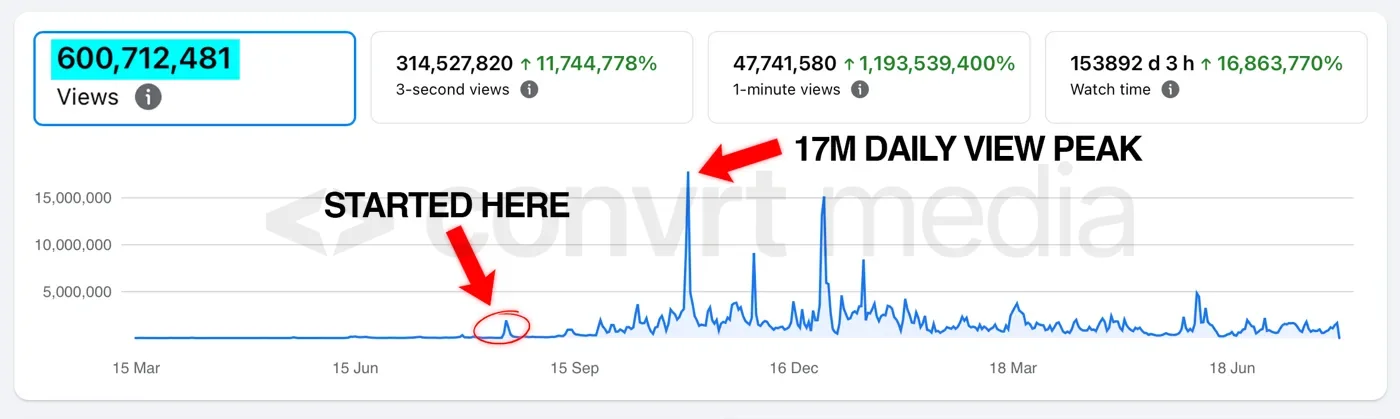
Prediction markets are licensed market by market, and in the US the picture changes state by state. Your marketing has to follow the same map. On owned accounts that means running each one from the country it serves and reading its audience by country every week. When we ran accounts for WTF Games, live breakdowns showed 71 percent of one account’s viewers in Chile and 89.3 percent of another’s in Sweden: the audience lands where the account is set up. For the current state of play, see are prediction markets legal.
With creators, ask for an audience breakdown by country before you book anyone, and check it again on the posts they deliver.
Measure attention, then double down
Track the numbers you can trust for every account and every post: views, link clicks, click-through rate and audience by country. Prediction markets have a natural test calendar, because every event is a new chance to try a hook or a format. Keep the ones that earn clicks, roll them out across every account and drop the rest.
A 90-day plan
| Weeks | What happens |
|---|---|
| 1 to 2 | Agree the countries, the events to own and the goal for month one. Set up four accounts per channel, one per platform, on dedicated devices in those countries. |
| 3 to 6 | Post every day around the calendar. Every post tests a hook, a format and a call to action. Read the audience by country weekly. |
| 7 to 10 | Roll the winning formats out across every account. Add disclosed creator campaigns around the biggest events. |
| 11 to 13 | Add markets or languages where the numbers justify it. Plan the next quarter around the events that earned the most clicks. |
This is how we work. For one financial market we launched a network of accounts from zero for the World Cup: 13.7 million views in the first three weeks, 34 million in 90 days and four times the web traffic. The next month the campaign tripled in size. Read the case study, or see how we run it on our prediction market marketing page. Comparing options? See every prediction market marketing agency side by side. For a pick’em app that grew with creator shows and athletes, then added event contracts, see our PrizePicks breakdown. For a fantasy app that built its own sports media network, paid creators in codes and equity, then launched its own exchange, see our Underdog breakdown. For one example, see our Novig marketing breakdown. For one sports exchange and its offers, see our ProphetX breakdown. For how a forecaster grew a newsletter to 382,000 subscribers around his models, see our Nate Silver breakdown. For a prediction market that grew on user-made markets, a newsletter and a festival, see our Manifold breakdown. For an exchange that leads each campaign with a product truth, see our Betfair breakdown. For a prediction market that grew by embedding markets in news stories, see our Myriad breakdown. For a prediction market that grew with creators, points and a daily referral programme, see our Limitless breakdown. For how one exchange markets yes or no questions with an interest-like coupon, see our ForecastEx breakdown. For how one prediction market restarted its brand by showing its work, see our Augur breakdown. For a prediction exchange that markets itself with a Learn hub built to be cited, see our Opinion.trade breakdown. For a protocol that markets itself through open metrics, open code and prediction games for brands, see our Polkamarkets breakdown. For a prediction market that became the first-ever Official Sports Trading Partner of SailGP on a focused budget, see our Smarkets breakdown.
Want this run for you on accounts you own? See how Content Teams works →
Frequently asked questions
Start with the channels you control. Post short-form video every day on accounts you own, built around the events people are already arguing about, and aim it only at the countries where you operate. Add disclosed creator campaigns for reach, a referral programme for word of mouth, and paid search only if you qualify for it. Track views, link clicks and click-through rate per account so you know which formats and events earn attention.
In the US, since 21 January 2026, yes for some. Google allows ads for exchange-listed event contracts from CFTC-authorized designated contract markets and from NFA-registered brokerages that give access to them, subject to Google certification. Offshore platforms are excluded. Check Google’s current Financial Services and Gambling and Games policies for your licence and locations, because the eligible list has changed since launch.
In the US, yes. The FTC’s Endorsement Guides say a paid endorsement usually needs a clear disclosure, and that the company is ultimately responsible for what others say on its behalf. The 2026 Wall Street Journal investigation into creators told not to disclose shows what happens when this is skipped: a lawsuit, letters from senators and a public audit.
Content about the event, not the product. Match previews, countdowns, reactions to live news and short explainers of what the odds say all give people a reason to form a view. The clip ends on the question and points to the market. Showing real, current odds is fine; staging wins or implying easy money is what drew legal trouble for others.
Convrt pricing is quoted per project. Content Teams are for founders and brands spending at least $10K a month on marketing. Creator campaigns are your campaign budget plus our retainer, quoted per campaign. Your exact quote is set on the strategy call.
- Covers, “Google Allows US Prediction Markets Ads” (Ziv Chen, Jan 2026)
- Track360, “Prediction Market Marketing: User Acquisition Channels in 2026” (Eyal Shlomo, June 2026)
- The Block, “Polymarket paid creators to stage fake winning bets on dummy sites: WSJ” (June 2026)
- CBS News, on Polymarket’s audit of its promotional content (June 2026)
- Federal Trade Commission, “FTC’s Endorsement Guides: What People Are Asking”
- NPR, “The clipping economy” (Bobby Allyn, May 2026)