Zerodha says it has never advertised and has no marketing team. Its 2020 tech blog says it let its services and products build its userbase, brand and trust.
In December 2015 it stopped charging brokerage on equity delivery trades. Nithin Kamath told BusinessLine the move created mega publicity, and in January 2019 it became India’s largest broker.
Free education, open source tools and a rule it calls user disengagement (no promo messages, no freebies, a fee to sign up) keep its growth on word of mouth.
Zerodha is an Indian stockbroker started in August 2010 by brothers Nithin and Nikhil Kamath. This breakdown covers the idea, the first customers, the referral system, zero brokerage, the product, Varsity and the blogs, user disengagement, the sign-up fee, open source, Rainmatter, the outages, the founders and the rules for finance creators in India.
Who Zerodha is
Wikipedia says: Zerodha was founded and bootstrapped by brothers Nithin and Nikhil Kamath.
Its About page says: We kick-started operations on the 15th of August, 2010 with the goal of breaking all barriers that traders and investors face in India in terms of cost, support, and technology. We named the company Zerodha, a combination of Zero and "Rodha", the Sanskrit word for barrier.
It is big now. The same page says: Over 1.8+ crore clients place billions of orders every year through our powerful ecosystem of investment platforms, contributing over 15% of all Indian retail trading volumes.
It also says: We pioneered the discount broking model in India. Wikipedia notes: They were recognised with the award 'Retail Brokerage of the year 2018', by National Stock Exchange.
None of that came from ads. Its tech blog said in 2020: We do not have a marketing team, have not advertised anywhere, and have let our services and products speak for themselves, building our userbase, brand, and trust over the years.
“Zerodha has never advertised its products or services.”Kailash Nadh on the Zerodha Tech blog
The idea
Nithin Kamath wrote for The Economic Times in 2012: I launched Zerodha in August 2010. My business idea was simple: offer lower broking costs compared with the typical brokerage charged by other stock brokers. In addition, we decided to concentrate on building an easy-to-use platform for traders.
He had seen the gap while working as a broker. He wrote: Over 90% of them wanted a simple, secure and stable trading platform to do their business, along with a strong customer feedback centre, which would answer their queries.
Forbes India put it this way in 2018: That was how Zerodha came into being, going live in August 2010. The brothers wanted to position themselves as facilitators of zero-barrier trading for their clients.
Trust mattered from day one. Kamath told Forbes India: We were the first to come up with a utility that showed all costs upfront, before a single trade was initiated by any client. BusinessLine reports that the firm put out a brokerage calculator to tell customers that what they saw there was what they would pay.
The CEO was easy to reach. BusinessLine adds: They also put up a blog saying customers can reach out to Nithin Kamath, CEO of Zerodha, any time.
The first customers
Kamath had a following before he had a company. BusinessLine reports that he had been building stock trading communities on Yahoo Messenger (up to 2,000 people strong) and Orkut (10,000 or so). He leveraged these communities to find customers.
It was still slow. For Zerodha, getting the first 5,000 customers was the hardest. Nithin recalls that it involved quite a lot of cold calling and the Kamaths leveraging some of their old pseudo-names.
Then the press came. In 2011, Zerodha got its first media coverage and from there the credibility shot up. It went on to open some 300-400 accounts a month and then to 700-1,000 accounts a month.
Word of mouth and a referral fee
In 2012 Kamath wrote: The average number of clients has gone up from 500 per month to about 1,500 in the past two years. All this just through word-of-mouth publicity.
He named the one paid lever: Instead, we have bet on a referral system, wherein every referrer gets 10% of the brokerage generated from the referred traders.
The team grew with the client list. He wrote that the company’s headcount has grown from just six at the outset to about 60 currently. We also set up customer centres in Hyderabad and Kochi last year.
Today the apps go the other way: they show no prompts to tell your friends.
Zero brokerage as publicity
Others copied the low fee. Forbes India notes: By 2013, competition had started using the discount broking model, too.
Then came the move that made headlines. Forbes India: In December 2015, they decided they would take no fee at all for trades on equity shares.
The Economic Times wrote at the time: This is the first time an Indian brokerage has decided to forgo fees for facilitating client trades. The ‘zero brokerage’ structure will be restricted to cash trades and not futures and options, Kamath said.
He was clear about the aim. He told the paper: We have not been able to grow exponentially. We add 5,000-6,000 clients every month but that is not enough. Hopefully, zero brokerage will double this count,
He later told BusinessLine why: The problem for us at this point of time was that the business was getting labelled as ‘only for active trading’. We wanted to break that image so we decided to announce zero brokerage for equity investing. This created mega publicity for us and helped break the image,
It worked. He told Forbes India: The zero brokerage idea caught the imagination of people, and that clientele jumped from about 70,000 people then to a million users today.
Wikipedia still sums up the pricing in four words: Equity delivery is commission-free.
For more on pricing as a growth lever, read how to market a trading app.
Largest broker
The Times of India reported in January 2019: In the last five years Zerodha’s annual growth rate in client addition has been in the range of 200-300%.
Its tech blog says: Zerodha became the largest stock broker in India in January 2019, trumping stock brokerages operated by mega-banks. We achieved this slowly and organically.
Wikipedia puts it this way: In 2019, Zerodha became the largest retail stockbroker in India by active client base.
Then the pandemic came. Kamath told BusinessLine in 2022: We were 20 lakh customers just before Covid and we touched 1 crore last week. Out of these, 70 lakh people have traded once a year in the last year.
Wikipedia gives slightly different counts: Zerodha had about 1.3 million customers in early 2020, which rose to nearly 10 million by the end of 2022. As of May 2024, it has 7.5 million active customers registered with the NSE, making it the second-largest stockbroker in India.
The tech blog said in 2020: In the last financial year that just ended, we executed more than 1 billion trades.
The product does the marketing
The app is the pitch. Forbes India writes: In mid-2015, they also launched a minimalistic, clutter-free product called Kite.
Mutual funds came next. Since March 2017, they have been offering mutual funds on a platform they introduced called Coin. Wikipedia says its fund house It focused on index funds and had only direct plans which paid no commissions to distributors.
Onboarding got easier. Kamath told BusinessLine: The tipping point in this journey was really Aadhaar for online onboarding around 2016- 2017. Because until then account opening involved physical forms, running to 30-40 pages and a slew of signatures.
The tech team is small. In 2013, Nithin met Kailash Nadh, who today heads Zerodha’s tech team. Wikipedia says Kailash Nadh joined Zerodha in 2013 to start its technology team.
The 2020 post says: TLDR: 30 member tech team formed over seven years built India’s largest stock broker. Products and technologies are built, maintained, and owned by small teams of two to four developers. There are no dedicated project or product managers, and developers step up to these roles and natural leaders emerge.
- 01Cost calculatorEvery cost shown before a trade.
- 02KiteA minimal, clutter-free trading app.
- 03CoinMutual funds since March 2017.
- 04Aadhaar sign-upOnline, not 30 to 40 pages of forms.
- 05NudgeDiscourages risky trades.
- 06Kill SwitchUsers can lock themselves out.
Free education: Varsity and the blogs
Zerodha teaches before it sells. Its About page says: In addition, we run a number of popular open online educational and community initiatives to empower retail traders and investors.
The biggest is Varsity. Its site says: It is free and openly accessible to everyone and is one of the largest financial education resources on the web. No signup, no pay-wall, no ads.
The About page credits one person: Karthik Rangappa wrote Varsity on his own.
There is a test too: An online certification program designed to test your market knowledge and give you the confidence to start your career in capital markets.
Traders can ask questions on TradingQnA, which promises: All your queries on trading and markets answered.
The company blogs in public. Z-Connect is described as Zerodha product and business updates, announcements, and blogs in one place. Subtext is a blog that focuses on in-depth exploration of finance, markets, and the economy. Its goal is to highlight the less obvious aspects and examine the 'why' instead of just the 'what'.
- 01VarsityFree, no signup, no ads.
- 02CertificationA test of market knowledge.
- 03TradingQnATrading questions answered.
- 04Z-ConnectProduct and business updates.
- 05SubtextThe why behind markets.
- 06Zerodha TechHow the tech team builds.
For the numbers on who trades, read our retail trading statistics.
User disengagement
In May 2022 Kailash Nadh, Zerodha’s CTO, wrote a post that names the philosophy.
He argues that the term user “engagement” in software, more often than not, is a thinly veiled proxy for user entrapment. So Zerodha chose to employ a philosophy that I would like to call user disengagement.
It has two tenets. Only do what is truly useful and meaningful to end users. Don’t do unto others, what you don’t want done unto you.
The post is blunt about ads: Zerodha has never advertised its products or services. No online or offline ads. No paid placements. No marketing team.
Its bet is simple: Our central thesis and conviction is that if our products and services are truly useful to end-users and are fairly priced, users will choose the products out of their own volition. Users who come that way and stay are highly likely to tell their peers about the product.
That shapes the whole company. When the growth strategy is word-of-mouth recommendations from users, it naturally directs all focus in the organisation to building products and services that are not only useful to users, but are good enough for them to recommend to their peers.
What Zerodha does not do
The post lists the habits it skips. No promotional or marketing e-mails, SMSes, or notifications are sent. There are no annoying “rate this app” or “tell your friends” popups.
Nobody appreciates uninvited non-personal phone calls. There is no tracking or profiling of user “engagement” across any of our apps.
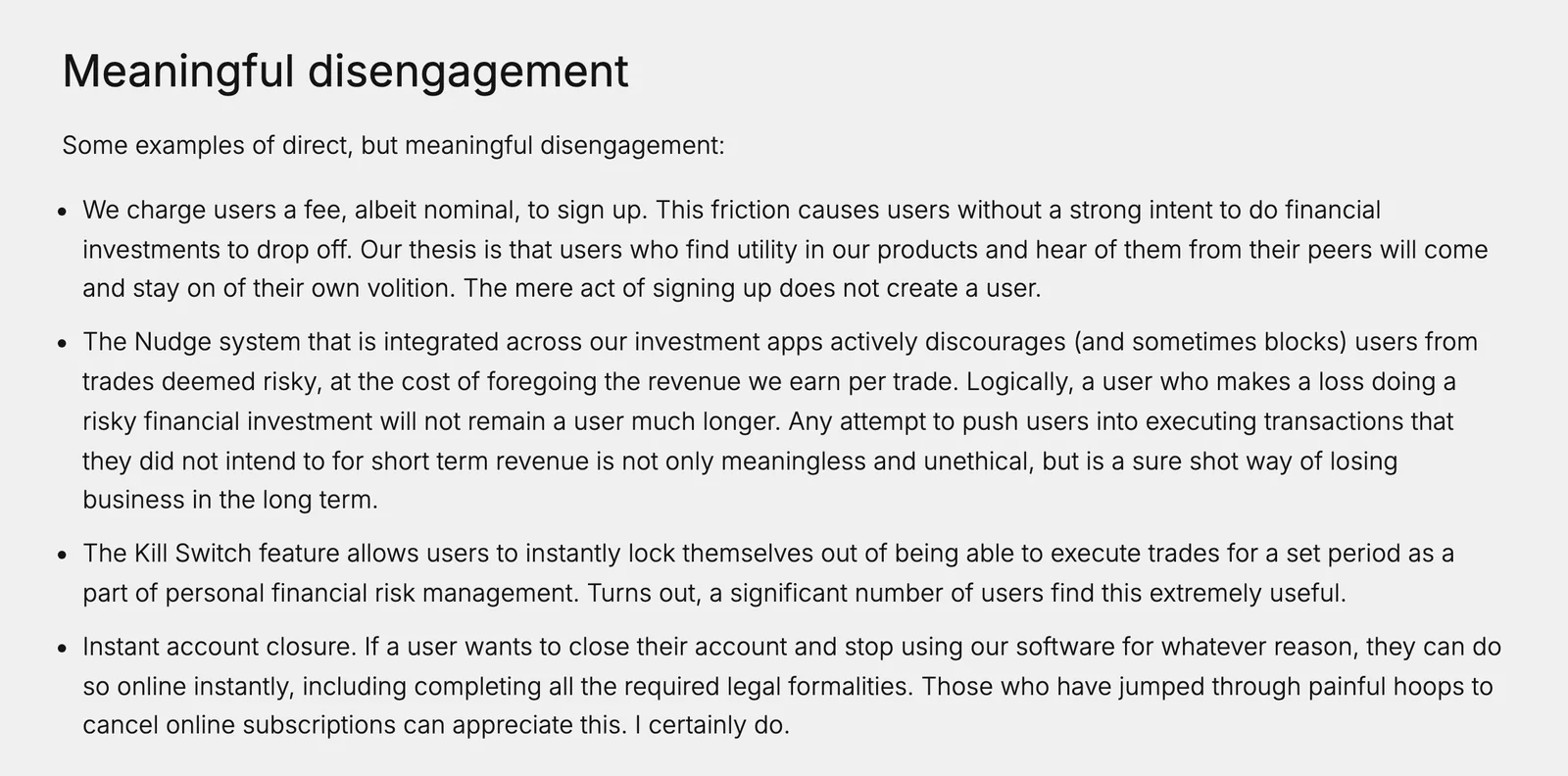
It also builds tools that cut into its own fees. The Nudge system that is integrated across our investment apps actively discourages (and sometimes blocks) users from trades deemed risky, at the cost of foregoing the revenue we earn per trade.
The Kill Switch feature allows users to instantly lock themselves out of being able to execute trades for a set period as a part of personal financial risk management. And leaving is easy: If a user wants to close their account and stop using our software for whatever reason, they can do so online instantly, including completing all the required legal formalities.
- 01No adsOnline, offline or paid placements.
- 02No promo messagesNo marketing emails, SMSes or notifications.
- 03No popupsNo rate this app or tell your friends.
- 04No cold callsNo uninvited non-personal calls.
- 05No trackingNo profiling of engagement.
- 06No freebiesNo discounts to sign up.
The sign-up fee
Zerodha charges people to join. We charge users a fee, albeit nominal, to sign up. This friction causes users without a strong intent to do financial investments to drop off. The mere act of signing up does not create a user.
Kamath told BusinessLine the fee stayed when costs fell: This was done because we want only people with intent to open an account.
He thinks it pays off. Nithin believes Zerodha’s decision to keep charging an account opening fee is one of the major reasons for the company’s high activation rate.
Nadh ends the post: Our experience at Zerodha over the last decade gives me the conviction to say that it is indeed possible. Not easy, but possible. This philosophy drives pretty much everything at Zerodha.
Open source
Engineers are an audience too. BusinessLine reports: Thanks to Nadh, Zerodha is completely built on free and open source software (FOSS) and is also one of the biggest contributors to FOSS in India.
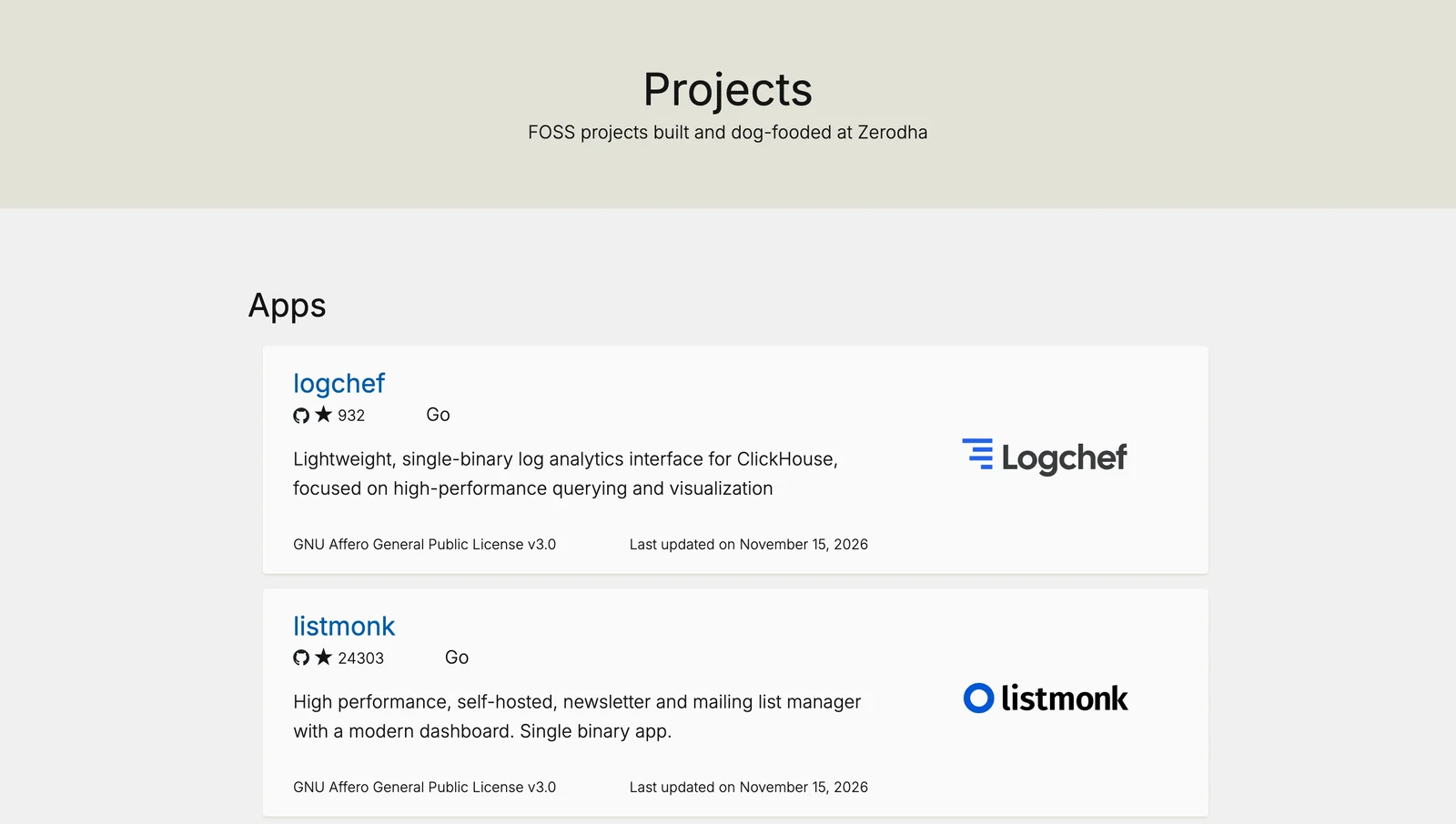
Its projects page lists FOSS projects built and dog-fooded at Zerodha. One of them is listmonk: High performance, self-hosted, newsletter and mailing list manager with a modern dashboard.
Wikipedia says listmonk was developed in part to allow Zerodha to send large volumes of email at minimal cost.
In 2024 it gave back. Wikipedia says: On 15 October 2024, Zerodha announced the launch of FLOSS Fund dedicated to Free/Libre and Open Source projects globally.
The Register quoted the company: A significant portion of our success and growth is owed to FOSS, encompassing everything from programming languages to operating systems, to databases, web servers, front-end frameworks, productivity tools, code editors, and absolutely everything. Applying is light: In order to apply, all that's required is publishing a funding.json manifest file on the open source project's website or code repository and submitting the URL to a fund directory.
Rainmatter
Forbes India writes that investing in startups was made more formal in 2015 under a unit called Rainmatter.
Its site says: We fund what should exist. Rainmatter invests Zerodha's profits in the things India needs to build. We invest our own money, so we're in no rush.
When the app goes down
A broker that grows on trust is judged on its bad days. Wikipedia reports: There have been multiple reports of technical issues, including glitches, system outages, and connectivity issues on Zerodha's Kite platform, especially on days with high market volatility and F&O expiry days. Zerodha, in an official statement, acknowledged the problem.
Nadh told Forbes India in 2018: others face this issue too, but when it happens with us, the scale causes a big outcry.
The founders
The founders talk in public instead of paying for ads. Wikipedia says of Nithin Kamath: The discount-broking model contributed to the firm's growth without significant spending on advertising or venture-capital funding.
His brother has a show. In March 2024, Kamath started hosting a podcast entitled "WTF is".
The rules for finance creators in India
Zerodha says it runs no paid placements, and Indian rules now limit what brokers can do with them. Outlook Business reported in October 2024: The latest circular follows SEBI’s decision of June 27 to ban association with unregistered content creators who offer advice or recommendations or make claims on the performance of any security.
Outlook Business quotes the circular: The regulated entities should not have any direct or indirect association with a person who makes any claim, of returns or performance expressly or impliedly, in respect of or related to a security or securities, unless the person has been permitted by the Board to make such a claim.
Business Today reported in August 2024: As per the latest tweaks, the persons regulated by SEBI and the agents of such persons will not have any association like any transaction involving money, referral of a client, interaction of information technology systems with any other person who, directly or indirectly, provides advice, recommendation or makes explicit claim of return. The responsibility lies with the registered entities to ensure their associates do not engage in such prohibited activities.
For creators who work with brands in the US, the FTC says: If you endorse a product through social media, your endorsement message should make it obvious when you have a relationship (“material connection”) with the brand.
- 01No return claimsUnless SEBI permits the person.
- 02No money linksNo transactions involving money.
- 03No referralsNo referral of a client.
- 04No system linksNo linked IT systems.
- 05On the firmRegistered firms answer for associates.
- 06Since June 2024A SEBI decision of 27 June.
See our guide to finfluencer marketing rules.
What any trading platform can copy
- 01Let the product sellBuild what users recommend.
- 02Show every costA calculator before the first trade.
- 03Make price newsZero brokerage drew the press.
- 04Teach for freeNo signup, no paywall, no ads.
- 05Filter for intentA small fee keeps serious users.
- 06Build in publicBlogs, open source and founders.
For more on the niche, read how to market a fintech app. For other brokers, see our Robinhood breakdown, our Webull breakdown and our Trading 212 breakdown. For an Indian investing app whose founders answered finance questions on Quora before they wrote blogs, see our Groww breakdown. For an Indian broker that put cricket at the centre of its marketing, see our Upstox breakdown. For an Indian trading platform that says it cannot grow its audience with ads and builds for power traders instead, see our Dhan breakdown. For an Indian broker that took a five-year IPL deal and paired it with free lessons, see our Angel One breakdown. For a broker that built a free learning platform, see our Sharesies breakdown. For a trading platform blog that began as a founder diary in 2012, see our QuantConnect breakdown.
We run creator content and posting for trading platforms on accounts you own, built for your compliance sign-off, with every post tracked for views, link clicks and click-through rate.
Frequently asked questions
No, by its own account. Its tech blog says Zerodha has never advertised its products or services, with no online or offline ads, no paid placements and no marketing team. Its 2020 Hello, World post says the company let its services and products speak for themselves.
BusinessLine reports that the first 5,000 customers were the hardest and took a lot of cold calling. Nithin Kamath had built stock trading communities on Yahoo Messenger and Orkut and used them to find customers. The firm got its first media coverage in 2011. In 2012 he told The Economic Times it relied on word of mouth and a referral system that paid referrers 10% of the brokerage from referred traders.
In December 2015. The Economic Times reported it as the first time an Indian brokerage had decided to forgo fees for client trades, limited to cash trades and not futures and options. Kamath later told BusinessLine the move created mega publicity and broke the image that Zerodha was only for active traders.
It is the name Kailash Nadh, Zerodha’s CTO, gives the company’s product philosophy. Zerodha sends no promotional emails, SMSes or notifications, shows no rate this app or tell your friends popups, does not track engagement and offers no freebies to sign up. Its Nudge system discourages risky trades, and a Kill Switch lets users lock themselves out of trading.
Its About page says over 1.8 crore clients place billions of orders every year. Wikipedia reports about 1.3 million customers in early 2020, nearly 10 million by the end of 2022, and 7.5 million active customers registered with the NSE as of May 2024.
- Zerodha Tech: Hello, World (Apr 2020)
- Zerodha Tech: User disengagement (May 2022)
- Zerodha: About
- Zerodha Varsity
- Rainmatter
- Zerodha: Z-Connect blog
- Zerodha Tech: Projects
- Forbes India: Nithin and Nikhil Kamath, Code Zero (Sep 2018)
- The Economic Times: how Nithin Kamath built Zerodha (Oct 2012)
- The Economic Times: Zerodha scraps fee for cash trades (Dec 2015)
- BusinessLine: The billionaire brokers (Sep 2022)
- The Times of India: Zerodha becomes largest broker (Jan 2019)
- The Register: Zerodha open source fund (Oct 2024)
- Wikipedia: Zerodha
- Wikipedia: Nithin Kamath
- Wikipedia: Nikhil Kamath
- Wikipedia: Kailash Nadh
- Outlook Business: SEBI orders regulated entities to cut ties with unregulated finfluencers (Oct 2024)
- Business Today: SEBI tweaks regulations for finfluencers (Aug 2024)
- TradingQnA
- FTC: Disclosures 101 for Social Media Influencers (Wayback copy)