Silver Bulletin had 382,000 subscribers by November 2026, per Wikipedia.
Silver puts the inflection point at two posts a week and says his models drive paid signups.
Polymarket named him to its advisory board in July 2024, and he says so in his posts.
Nate Silver called 49 of 50 states in 2008 and built FiveThirtyEight on it. Since 2023 he has run Silver Bulletin, a newsletter of essays and models. This breakdown covers his path, his seven tips for growing a newsletter, why he ignores engagement, his podcasts and book, his Polymarket role, and the disclosure rules for creators who work with prediction markets.
Who Nate Silver is
Nate Silver is a forecaster who writes for a living. Wikipedia calls him an American statistician, political analyst, author, sports gambler, and poker player. He is the founder of FiveThirtyEight and held the position of editor-in-chief there, along with being a special correspondent for ABC News until May 2023.
His first models were about baseball. Silver produced the PECOTA forecasts for each Major League Baseball season from 2003 through 2009.
Today, Wikipedia says, Silver has been publishing in his online newsletter Silver Bulletin and serves as an advisor to Polymarket.
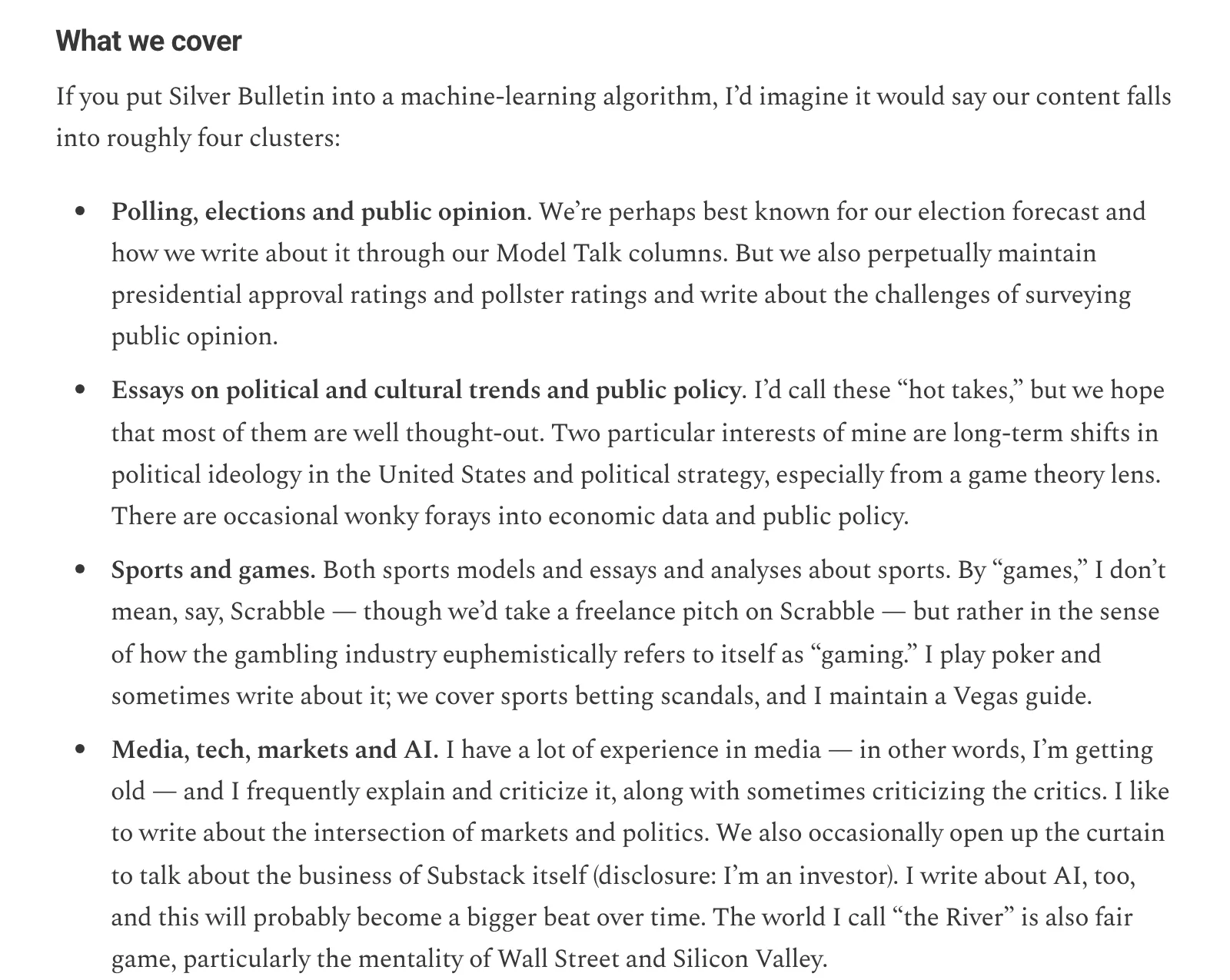
His own about page sorts the work: If you put Silver Bulletin into a machine-learning algorithm, I’d imagine it would say our content falls into roughly four clusters. They are polling and elections, essays, sports and games, and media, tech, markets and AI. On the first, he writes: We’re perhaps best known for our election forecast and how we write about it through our Model Talk columns.
The site itself is simple. We break our posts into two main sections: Politics and Sports. On the games side he adds: I play poker and sometimes write about it.
“Being first to a story, or better yet, having the first authoritative take on the story, counts for a lot.”Nate Silver, in Silver Bulletin
From Poblano to FiveThirtyEight
Silver started under another name. On November 1, 2007, while still employed by Baseball Prospectus, Silver began publishing a diary under the pseudonym "Poblano".
Then he went out on his own. On March 7, 2008, while still writing as "Poblano", Silver established his own blog, FiveThirtyEight.com. The name has a reason: the website takes its name from the number of electors in the United States electoral college.
On May 30, 2008, Poblano revealed his identity to FiveThirtyEight.com readers. He first appeared on national television on CNN that June.
Then came the result that made him famous. Silver's final 2008 presidential election forecast accurately predicted the winner of 49 of the 50 states and the District of Columbia. Wikipedia notes: Silver was named one of the world's 100 most influential people by Time in 2009 after his election forecasting model correctly predicted the outcomes in 49 of 50 states in the 2008 U.S. presidential election.
Big media followed. The New York Times "FiveThirtyEight: Nate Silver's Political Calculus" commenced on August 25, 2010. The partnership agreement, which is structured as a license, has a term of three years.
The traffic was huge. Wikipedia quotes a report from the 2012 race: That is, one in five visitors to the sixth-most-trafficked U.S. news site took a look at Silver's blog.
His first book came out the same year. The Signal and The Noise was published in the United States on September 27, 2012.
On 22 July 2013 ESPN announced that it had acquired ownership of the FiveThirtyEight website and brand. In 2018, the Walt Disney Company transferred the FiveThirtyEight site from the ESPN division to the ABC News division. After he left, a smaller FiveThirtyEight continued to operate under the data analytics division of ABC News, until being shut down in March 2025.
His 2016 call stood out too. He gave Donald Trump, the eventual winner, a 28.6% chance of victory in the 2016 presidential election, a higher estimate than other major scientific forecasts.
Going solo: Silver Bulletin
After departing FiveThirtyEight amid widespread layoffs at Disney/ABC News in May 2023, Silver began publishing on his personal blog, Silver Bulletin. He kept his model. Silver retained the IP of 538's election forecasting model as he left, and in June 2024, released his own election forecasting model at Silver Bulletin.
Money came early. Silver Bulletin launched paid subscriptions in September 2023. Paid subscribers get every article, the models (updated ~daily) and the full archive.
He says the plan was always bigger than email: But the long-term plan was never for Silver Bulletin to be “just” a newsletter but rather a bundle of essays and models.
The models are the draw. Of the sports models, he writes: As with the election model, they’re meant to be viewed on the web, both because of all the fancy graphics and because they’re updated nearly every day.
He guards the inbox. I just think it’s worth it to create an expectation that when Silver Bulletin sends you an email, it’s worth opening and reading. Even for his own book, he says, “I published just two standalone posts.”
Always Be Blogging: his seven tips
In November 2024 Silver shared seven tips for a successful Substack. The first is a motto. My version of this is ABB: Always Be Blogging.
His case is simple. Substack produces relatively linear rewards for the effort you put in. I strongly suggest there is an inflection point for a successful Substacker at publishing at least two items per week.
He lived it. In 2024, he writes, we were publishing 5-ish times a week during the election peak, plus updating the model every day.
Pace matters because posts fade fast. Well, newsletters typically have a shelf life of two or three days. He also mixes free and paid: I suggest that the ratio of paid-to-free posts be somewhere in the vicinity of 50:50.
His second tip is to stretch singles into doubles. And there are four mechanisms to get those stretch doubles, starting with the headline and the lede. On headlines: Far more people see the headline than read the article. Clickbait is the trap, because “you don’t want clicks; you want subscriptions.”
Third, home runs come from timely, differentiated content. The most popular post in Silver Bulletin history, outside of the model landing pages, is this one on Ann Selzer’s Iowa poll. But it got almost 350,000 views that night and an equal number the next day. He explains why: Being first to a story, or better yet, having the first authoritative take on the story, counts for a lot.
The fourth is to think before you type. Most of the writing process is figuring out what you want to say. The fifth is to waste nothing: in cooking, nose-to-tail means you want to use the whole animal to avoid wastage. For a newsletter, you don’t want to spend a bunch of time thinking about a subject and then not getting a newsletter or two out of it. The sixth is speed: Writing well quickly is a force multiplier for everything you do in your Substack.
The seventh is to play the long game. Building up awareness of your new brand will probably take at least six months. Once your newsletter hits a certain level of maturity, keeping existing subscribers happy is the most important priority. And check the numbers: I’d recommend reviewing your posts once a month and looking at which overperformed or underperformed relative to your expectations.
How the list grew
The election model was the engine. In August 2024 he wrote: In a few hours, this newsletter will cross the 167,000 total (free + paid) subscriber mark. We’ve been netting about 1,800 subscribers per day since we turned the election model on.
Sports models work too. The NCAA forecast tripled paid subscriptions basically overnight.
He added a place to talk: today we’re announcing a new addition to this publication: Silver Bulletin subscriber Chat.
By November 2024, Wikipedia says, his blog was ranked third on the Substack politics leaderboard with 282,000 subscribers. As of November 2026, Silver's Substack has 382,000 subscribers.
For how other creators grow a list from long content, see our Caleb Hammer breakdown and our Graham Stephan breakdown.
Why he ignores engagement
In April 2026 Silver wrote that likes and comments mislead. Substack basically gives you seven different metrics to play with. But: If you look at every Silver Bulletin post over the past six months, the correlation between “engagement” metrics and paid signups is literally almost zero or, in some cases, even slightly negative.
What works instead? His models, he writes, often do disproportionately well as a driver of paid subscriptions and can also produce a disproportionate number of pageviews since they’re updated repeatedly.
His reason: But the impulse to like a story and to pay for a story don’t really come from the same place.
He also explains why email beats feeds. Newsletters are a slow burn compared to other ways of distributing content, relying more on referrals and word-of-mouth and with a longer shelf life. The medium-term outlook for Twitter/X and other social media platforms is unstable, so subscribing is the easiest way to stay in touch.
The lesson for any creator: track what pays, not what gets clapped. For the numbers behind finance creators, read our finfluencer statistics.
- 01Engagement metricsAlmost zero correlation with paid signups over six months.
- 02ModelsOften disproportionately well as a driver of paid subscriptions.
- 03Deep divesThe NBA draft model did well for paid, if lonely in the comments.
- 04Election and NCAA modelsAbout 1,800 subscribers a day; the NCAA forecast tripled paid.
Podcasts and a book
Silver also talks for a living. Risky Business is a weekly podcast about making better decisions. The hosts, Maria Konnikova and Nate Silver, are both journalists who moonlight as high-stakes poker players. Risky Business is a co-production of iHeart Media and Pushkin Industries.
That show has ended. Pushkin lists a last episode: In the final episode of Risky Business, Nate and Maria check in on the predictions they made back in January for 2025.
In 2026 he went back to his old team. Wikipedia says the original hosts of the 538 politics podcast reunited for a new podcast, Still Counting, on the Crooked Media network.
Crooked sums the show up: What the data can, and can’t, tell us about American politics. Each week, Nate Silver, Clare Malone and Galen Druke dig into the latest in politics and the numbers behind it. They’ll be covering everything from elections to betting markets to AI.
In August 2024, Silver published his book On the Edge: The Art of Risking Everything, exploring how calculated risks can yield benefits in diverse fields, from finance and poker to effective altruism. The publisher says: Nate Silver’s On The Edge reveals the hidden world of the River. It is the domain of gamblers and like-minded folks who move markets and change the fabric of society. Silver embeds with them, competing in the World Series of Poker, visiting Sam Bankman-Fried’s FTX compound, and attending wild Miami yacht parties at the height of the crypto bubble.
The poker is real. Silver plays poker semi-professionally. Wikipedia lists his results, including an 87th-place finish in the 2023 World Series of Poker Main Event.
For how a long show becomes daily clips, read how to grow a podcast with clips.
- 01Silver BulletinThe newsletter, in Politics and Sports.
- 02Models on the webUpdated nearly every day.
- 03Still CountingA weekly podcast on Crooked Media.
- 04Risky BusinessA podcast with Maria Konnikova, now ended.
- 05On the EdgeHis 2024 book on risk and the River.
- 06PolymarketIts advisory board, from July 2024.
Polymarket and prediction markets
On 16 July 2024 Polymarket put out a release. The company said it welcomes statistician and FiveThirtyEight founder Nate Silver who will join the company's advisory board.
Silver joins former CFTC Chairman J. Christopher Giancarlo on the advisory board.
Shayne Coplan, the founder and CEO, said: “I grew up following Nate's work on election forecasting and it's a dream come true to welcome him to Polymarket's advisory board.” He added: “Over the course of his career Nate has played a pivotal role in mainstreaming political forecasting.”
Silver said: “I'm thrilled to join Polymarket as an advisor. Prediction markets are playing an increasingly vital role in helping people understand and plan for the future.” He went on: “In the context of the current election, we've already seen how valuable it is to have a real-time data source about questions like the effects of the debate that are otherwise hard to quantify.”
His own posts keep the tie in view. A November 2025 post carries the caption A Polymarket electronic billboard in Times Square. He opens: As an advisor to Polymarket, I’m obviously happy to see all the attention to prediction markets. And he does not cheerlead: In that capacity, I strongly disagree with the notion that prediction markets can serve as a good substitute for polls.
He has also written about how much mindshare prediction markets have gained over the past couple of years.
For the markets themselves, see our Polymarket breakdown, our Kalshi breakdown and our guide to what a prediction market is.
The rules for creators who work with prediction markets
Silver names his role at the top of the post, which is the habit US guidance asks for. The FTC tells creators: If you endorse a product through social media, your endorsement message should make it obvious when you have a relationship (“material connection”) with the brand.
The rule itself says: When there exists a connection between the endorser and the seller of the advertised product that might materially affect the weight or credibility of the endorsement, and that connection is not reasonably expected by the audience, such connection must be disclosed clearly and conspicuously. Material connections can include a business, family, or personal relationship.
So a creator who advises a market, holds a stake or is paid per post should say so in the post itself. For the wider picture, read are prediction markets legal, prediction market influencer marketing and finfluencer marketing rules.
What any prediction market creator can copy
- 01Post at least twice a weekHis inflection point for a newsletter.
- 02Work the headlineFar more people see it than read the piece.
- 03Be first with authorityThe first real take becomes the one everyone links to.
- 04Build a model people return toUpdated daily, it drives paid signups.
- 05Measure paid, not likesEngagement barely tracked his paid signups.
- 06Name every tieHe opens with “As an advisor to Polymarket”.
For the numbers behind the niche, read our prediction market statistics and how to market a prediction market. For other prediction market brands, see our PredictIt breakdown, our Novig breakdown and our ProphetX breakdown. For the play-money prediction market whose festival poker final table he sat at, see our Manifold breakdown. For a forecasting company that explains calibration and the Brier score in plain words, see our Hypermind breakdown. For a forecasting site that scores every forecast with a Brier score, where lower is better, like in golf, see our Good Judgment Open breakdown.
We run creator and clipping campaigns for financial products on accounts set up in the markets you are licensed for, with briefs, approvals and disclosure checked before anything goes out, and every post tracked.
Frequently asked questions
Wikipedia calls him an American statistician, political analyst, author, sports gambler and poker player. He founded FiveThirtyEight and left it in May 2023. Since then he has published Silver Bulletin and serves as an advisor to Polymarket.
It is Nate Silver’s newsletter on Substack, split into Politics and Sports. It launched paid subscriptions in September 2023, and paid subscribers get the models, updated about daily. Wikipedia says it had 382,000 subscribers as of November 2026.
Yes. Polymarket announced on 16 July 2024 that he would join its advisory board, alongside former CFTC Chairman J. Christopher Giancarlo. He names the role in his own posts about prediction markets.
He suggests a successful Substacker hits an inflection point at publishing at least two items per week. He wrote that Silver Bulletin published about five times a week during the 2024 election peak, plus daily model updates.
In April 2026 he wrote that, across six months of posts, the correlation between engagement metrics and paid signups was almost zero or even slightly negative. His models often do disproportionately well at driving paid subscriptions.
- Wikipedia: Nate Silver
- PR Newswire: Nate Silver Joins Polymarket Ahead of 2024 Election
- Silver Bulletin: About
- Silver Bulletin: Always. Be. Blogging.
- Silver Bulletin: "Engagement" is a dumb metric
- Silver Bulletin: How to use Silver Bulletin
- Silver Bulletin: SBSQ #11b, On the future of the newsletter
- Silver Bulletin: SBSQ #26, Do prediction markets make polls useless?
- Pushkin: Risky Business with Nate Silver and Maria Konnikova
- Crooked Media: Still Counting
- Penguin Random House: On the Edge by Nate Silver
- FTC: Disclosures 101 for Social Media Influencers (Wayback copy)
- eCFR: 16 CFR 255.5