Prop firms grow on creators and affiliates. FTMO pays affiliates up to 20%, and close to 80% of its revenue comes from returning clients, so community matters as much as the first sale.
The rules caught up in 2026. The FCA got seven influencers sentenced for promoting an unauthorised forex scheme, ESMA told finfluencers that a “not investment advice” line will not protect them, and ASIC said firms are liable for what their creators say.
Paid search and social ads for CFDs and forex are restricted on Google, TikTok and Meta, which pushes the category towards owned short-form and disclosed creator campaigns.
Why prop firms are hard to market
The product is simple to explain and easy to oversell. Most people who buy a challenge do not get funded: Topstep publishes that 12.4% of its traders got funded in 2024, and Finance Magnates reports that advertised payout totals are often padded, with some firms that “include vendor costs and other expenses in their payout claims to inflate the figure.” The FCA repeats its own figure every time it acts: 80% of customers lose money trading CFDs. If you are new to the model, start with what a prop firm is and how the challenge works.
Regulators have noticed the gap between the posts and the odds. Italy’s Consob described prop firm evaluations as “a type of finance video game”, and Belgium’s FSMA and Spain’s CNMV issued warnings of their own. The market is also crowded and fragile: Finance Magnates Intelligence estimated that between 80 and 100 prop firms shut down in 2024. Trust is the scarce resource, and marketing either builds it or spends it.
 Became a global meme


The channels that work
- 01Affiliates and creatorsThis is the engine of the category. FTMO’s programme pays up to 20% on its CFD challenges, and FundedNext says “Top creators and communities, with combined reach in the tens of millions, currently promote FundedNext.” Apex Trader Funding’s founder put the growth down to one thing: “the word of mouth is getting out.”
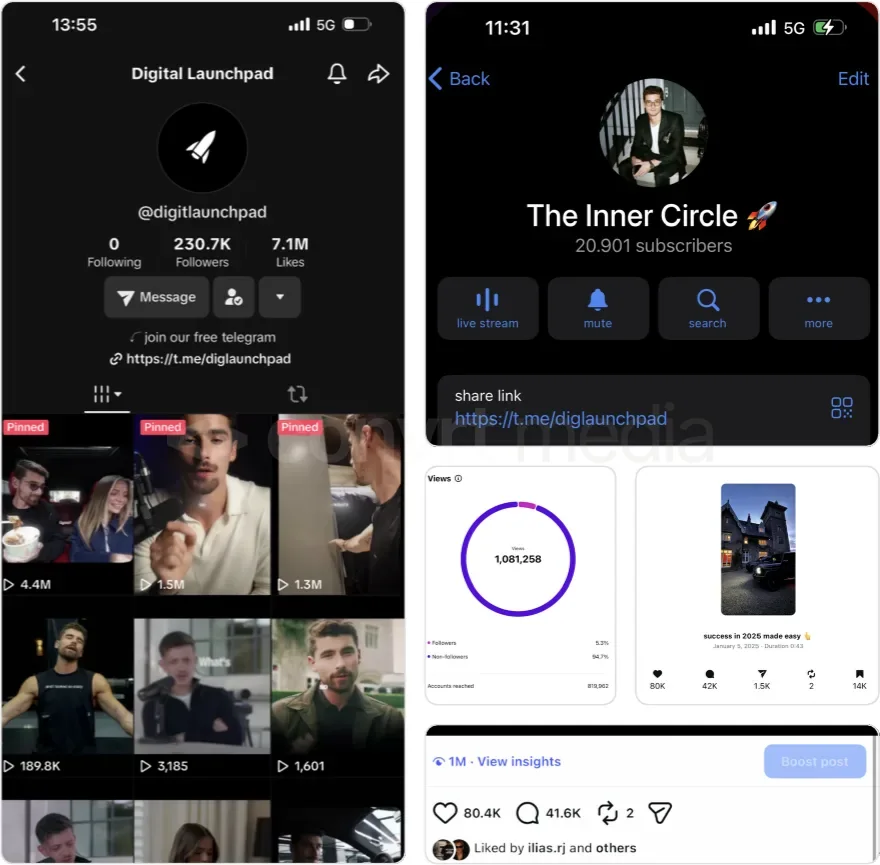
- 02Owned short-formAccounts the firm controls, posting every day about markets, rules and traders, aimed at the countries it serves. It is the one channel no affiliate can misattribute and no ad policy can switch off.
- 03Community and retentionClose to 80% of FTMO’s revenue comes from returning clients. The traders who stay are the ones who learn, so education, Discord and live sessions pay for themselves.
- 04Sports and brandThe bigger firms buy fame. Tradeify signed UFC’s Israel Adesanya, darts champion Luke Littler and cricketer Travis Head, and Topstep’s 2026 campaign with halfpipe skier Alex Ferreira is “now airing on NBC, Peacock, and other digital platforms.” Across retail trading brands, Sportquake data counted $183 million of sports sponsorship in the 2024 to 2025 season.
The audience is already on these feeds. FINRA Foundation research found that 26% of investors use recommendations from social media influencers, and YouTube was the most used platform, by 61% of those under 35. More checked figures on retail traders are in our retail trading statistics.
Where paid ads are closed
Search and social ads are a narrow door for this category. Google restricts ads for complex speculative financial products, including CFDs and rolling spot forex, to approved advertisers in certain countries, and disapproves “Ad destinations that provide signals for the trading of complex speculative financial products.” TikTok’s financial services policy asks for enhanced transparency and bans CFD ads in several countries. Meta is under pressure too: Reuters reported 1,052 ads for currency trading and complex instruments from unauthorised advertisers in a single week.
Firms also close their own brand search to partners. FTMO’s affiliate terms allow “no direct bidding on FTMO-branded keywords”. The result is the same everywhere: the reach that matters is organic, so the content has to earn it.
The rules in 2026
- UK. FCA guidance FG24/1 says unauthorised influencers who promote a regulated financial product may be committing a criminal offence. In February 2026 seven influencers with a combined Instagram following of 4.5 million were sentenced for promoting an unauthorised forex scheme. The FCA’s enforcement director: “These influencers betrayed the trust of those who followed them.” In April it led a global week of action that found 1,267 illegal financial adverts on Meta.
- EU. ESMA’s factsheet names CFDs, forex and futures among the products finfluencers commonly market, and opens with: “Promoting a financial product or service isn’t like promoting shoes or watches.” Paid posts need Ad, Paid partnership or Sponsored, “Not in tiny text. Not just hashtags.” And for educational videos that cross into advice: “Disclaimers such as ‘This is not investment advice’ will not protect you in these cases.”
- Australia. ASIC issued warning notices to four finfluencers and was blunt about who carries the risk: “We expect active supervision, not a set-and-forget approach.”
- US. The CFTC’s case against My Forex Funds collapsed in May 2025, when a judge dismissed it with prejudice and approved sanctions against the regulator. That did not loosen the platforms: MetaQuotes had already cut off prop firms serving US clients in 2024, and FTMO only returned to the US in 2025 through the regulated broker OANDA. The FTC’s disclosure rules apply to every creator either way.
For the country-by-country detail, see our guide to finfluencer marketing rules. For the numbers behind them, see our finfluencer statistics.
The mistakes that cost firms
- Paying per signup and never reading the posts. FINRA fined M1 Finance $850,000 over a programme of around 1,700 influencers paid a flat fee per new customer, whose posts it did not review.
- Trusting attribution you cannot check. In October 2026 Topstep, Apex, Tradeify and Goat Funded Trader cut ties with the comparison site Prop Firm Match over affiliate tracking. The site’s response: “This should not have happened. We take full responsibility for it.”
- Selling the payout, not the odds. Screenshots of big withdrawals with no funded rate next to them are exactly what the FCA, ESMA and ASIC are now looking for.
- Leaving disclosure to the creator. The FTC says to disclose “both in the videos and in the description near the links”, and to add your own label even when the platform offers one.
What to post
The firms that last post about trading, not about money. Market recaps on the day, rule explainers, challenge walkthroughs, trader routines, losses and what was learned, and published funded rates next to the wins. That content is useful enough to be shared, safe enough to survive a regulator’s review, and it keeps the returning clients who make up most of the revenue.
A 90-day plan
- Days 1 to 30. Map where you are licensed or allowed to serve, write the claims you will and will not make, and set up owned accounts in those markets. Start posting daily short-form about markets and rules.
- Days 31 to 60. Brief a first group of creators, with every script approved before it goes out, disclosure in the video and next to the link, and links tracked per creator. Cut anyone whose traffic you cannot verify.
- Days 61 to 90. Measure views, link clicks and click-through rate per account and per creator, roll the winning formats out across every account, and drop the rest.
For the agencies that do this work, see our guide to trading platform marketing agencies. To run it with us, see our trading platform marketing. For brokers and trading apps, see how to market a trading app or broker. For one prop firm in detail, see how FTMO markets. For a futures prop firm that markets with a live show, see how Topstep markets. For a prop firm that grows through trading educators and partner codes, see how FundedNext markets.
Want this run for you on accounts you own? See how Content Teams works →
Frequently asked questions
Mostly through creators and affiliates. Trading YouTubers, TikTok and Instagram accounts, Discord communities and comparison sites promote firms with discount codes and earn a share of each challenge sold. FTMO’s affiliate programme pays up to 20%, and FundedNext says creators and communities with a combined reach in the tens of millions promote it. Larger firms add athlete deals and TV campaigns on top.
Only within tight limits. Google restricts ads for complex speculative financial products such as CFDs and rolling spot forex to approved advertisers in certain countries, and disapproves ads that lead to trading-signal sites. TikTok’s financial services policy demands extra transparency from financial advertisers and bans CFD ads in several countries. Many firms rely on organic short-form and creators instead.
Yes. In the US the FTC says affiliate creators should disclose the relationship in the video and next to the links, and should add their own label even when the platform has a disclosure tool. In the EU, ESMA says to use words such as Ad, Paid partnership or Sponsored, not in tiny text and not just hashtags. In the UK, promoting a regulated product without authorisation can be a criminal offence.
Increasingly, the firm. ASIC says licensees remain responsible and liable for what their representatives say and do online, and expects active supervision, not a set-and-forget approach. In the US, FINRA fined the broker M1 Finance $850,000 in 2024 over a programme of around 1,700 paid influencers whose posts it did not review.
Content about trading itself: market moves, trader routines, rule explainers, challenge walkthroughs and honest results. Avoid payout screenshots that imply typical earnings and lifestyle claims. Topstep publishes that 12.4% of its traders got funded in 2024, which is the kind of number regulators expect you to show next to the success stories.
- FCA, influencers sentenced for unauthorised financial promotions (Feb 2026)
- FCA, FG24/1 finalised guidance on financial promotions on social media (March 2024)
- FCA, global action against illegal finfluencers (April 2026)
- ASIC, 26-081MR finfluencer crackdown alongside global regulators (April 2026)
- ESMA, finfluencer factsheet (Jan 2026)
- Finance Magnates, Consob warns against prop firms (July 2024)
- Finance Magnates, My Forex Funds parent defeats CFTC in court (May 2025)
- Finance Magnates, FTMO returns to the US through OANDA (Aug 2025)
- Finance Magnates, up to 100 prop firms shut in 2024 (March 2025)
- Finance Magnates, can you trust prop firms’ total payout claims? (June 2025)
- Finance Magnates, FTMO paid $422 million for OANDA (Sept 2026)
- Finance Magnates, prop firms cut ties with Prop Firm Match (Oct 2026)
- Finance Magnates, Tradeify signs Travis Head (April 2026)
- Finance Magnates, retail trading brands’ sports sponsorship spend (May 2025)
- Business Insider via Yahoo Finance, inside the prop trading industry (Dec 2025)
- FTMO, affiliate programme
- FundedNext, affiliate programme
- Topstep, 2026 brand campaign
- Google Ads policy, financial products and services
- TikTok Ads policy, financial services (Sept 2026)
- Reuters via The Star, unauthorised financial ads on Meta (March 2026)
- FTC, Endorsement Guides: what people are asking
- Fortune, FINRA fines M1 Finance over influencers (March 2024)
- FINRA Foundation, investor behaviour research (Dec 2025)