She built her audience without ads, posting on Instagram every day for two or three years before TikTok made her following skyrocket in 2020, she told Business Insider.
When 60 seconds was too short, her team launched the Financial Feminist podcast, which hit No. 1 on Apple Business charts within 72 hours, Entrepreneur reported.
A bestselling book, a Facebook group of more than 100,000 members, free quizzes and challenges, and paid programs followed.
Tori Dunlap is the founder of Her First $100K, a financial education company aimed at young women. This breakdown covers her start, the blog, her rule of serve before you sell, the TikTok formula, the medical bill video, the move to a podcast, the book, the community, the free resources, the programs, her brand work and the rules for finance creators.
Who Tori Dunlap is
Fortune wrote in October 2022: Dunlap, 28, is the founder and CEO of Her First $100K, a financial education platform for women.
Wikipedia says: After graduating from college, Dunlap began an entry-level job as a digital marketing manager in Seattle. At the age of 22, she started a financial education blog, it adds.
Of the company, Wikipedia says: The company sells webinars and programs. It also produces a podcast. It adds: Dunlap has stated that she tries to align her company's business practices with her advice.
Her press page lists Forbes 30 Under 30 2023.
“Serve before you sell.”Tori Dunlap to Business Insider
Before the blog
She started selling early. Her company’s About page says: My financial feminist journey started with me starting my first business at age nine. I owned the type of vending machines where you put in a quarter and get a handful of candy out. I had fifteen of these machines by the time I was in high school with all of the proceeds going to my college fund.
She studied, then worked in marketing. I have degrees in organizational communication (marketing with less math) and theatre. I was running marketing at a major company as their youngest manager.
People already came to her with money questions. She told The Seattle Times: As I was coming into adulthood after graduating college, I found that all my friends were coming to me for financial advice.
- 01Age nineHer first business: candy vending machines.
- 02High schoolFifteen machines, proceeds to her college fund.
- 03DegreesOrganizational communication and theatre.
- 04First jobDigital marketing in Seattle.
- 05Youngest managerRunning marketing at a major company.
- 06FriendsComing to her for money advice.
The blog and the goal
Business Insider reports: Tori Dunlap launched her blog in 2016 with just $40. At the time, her only expenses were the domain name and website registration.
The Cut described her in 2019 as a digital marketing manager based in Seattle. Her goal was to save $100,000 by age 25.
She wrote it all down in public. She told The Seattle Times: I documented my journey of saving $100,000 by age 25 on the Her First $100K blog.
Wikipedia says: She reached that goal in 2019. Her About page puts it this way: But at 25 years and 3 months old, I hit my first $100K.
The Cut added: She also made extra money from a side business that she spun out of her savings strategy, Her First $100K.
The press followed. Good Morning America wrote in October 2019: Dunlap was featured in CNBC and The Cut for impressively saving $100,000 in three years.
The call that changed the job
She told The Seattle Times: While I was on vacation to celebrate, I got a call for an interview on “Good Morning America.” Three weeks after the interview, I quit my full-time job and didn't look back.
Her About page tells it the same way: I did the interview and quit my job 3 weeks later.
CNBC wrote in 2024: What began as a side hustle on top of a marketing job has grown to a multiplatform product since Dunlap took the leap to run Her First $100K full time in 2019.
Serve before you sell
Her rule for selling is short. She told Business Insider: That's why my mantra is, "Serve before you sell." Instead, you need to provide a ton of value for people, get people's trust, and then sell them when they're already on board.
She also chose not to pay for reach. In the same piece she says: Part of the reason I decided to build completely organically on social media was that I didn't want to pay for ads, nor did I want to play the game of guessing which ads would be worth it. For Her First $100K, I spent $20 on Facebook ads once. Everything else has been organic.
Organic took time. She writes: I clawed my way to 33,000 Instagram followers by posting every single day for two or three years. Then, when I joined TikTok in 2020, my following skyrocketed.
Why TikTok worked
Her About page credits the app: But thanks to the power of TikTok and viral videos, I was able to connect with all of you and really dive into my journey with financial education.
Fortune adds: Although Dunlap said her business was already successful before she started creating content on TikTok in 2020, she knows that her social media presence has propelled it even further. TikTok is so incredibly important to our business, she told the magazine.
It also reached people she did not expect. Fortune notes that the focus on social media has helped her reach audiences, like Gen Zers, who she didn't initially think would be interested.
She told CNBC what TikTok does well: One of the things that TikTok has done really well, of course, is make advice accessible.
She has a test for a video. Entrepreneur reports that the ideal content will accomplish three things simultaneously: It will be educational, aspirational and entertaining.
- 01EducationalTeach one money topic.
- 02AspirationalShow what could be possible.
- 03EntertainingWorth watching to the end.
- 04No shameA nonjudgmental space to learn.
- 05AccessibleAdvice anyone can use.
- 06PersonalDrawn from her own life.
A no-shame voice
Her tone is part of the format. She told Entrepreneur: You have to give people a nonjudgmental space to learn about money from someone who isn't shaming them for not knowing something. And when you start talking, especially to women, not only might they not know these things, but they're also too embarrassed to ask.
I'm talking about a very taboo topic, she told the magazine.
Fortune says: Her business, podcast, and TikToks are all about a "no shame" approach, something she says the financial world is lacking. It adds that her content goes beyond what may be considered "typical" financial advice, like her thoughts on financial red flags in relationships and whether to combine finances with a partner.
CNBC reported in 2024 that in her words, a lot of what was out there felt "bro-y" and out of touch with a young woman's experience.
The medical bill video
In March 2021 The Guardian profiled her and a former debt collector, two creators who tell people how to gain control of debt in 15-60 seconds.
The paper wrote: Last year, her TikTok video explaining how to negotiate medical bills went viral, surpassing 1m likes. She records herself negotiating the bill with the medical office.
Her videos come from personal experience. She told the paper: I watched my dad growing up negotiate our cable bill, negotiate our car insurance, negotiate our phone bill.
The video started conversations. Stories and questions from young people about Dunlap's tips flooded the comments section of her video.
Then she turned it into a resource. To save time explaining what to say to medical billing departments, Dunlap keeps a free script on her website about how to negotiate common recurring bills.
For more on this kind of creator, read what a finfluencer is.
How big the audience got
The numbers grew fast. In June 2021 Entrepreneur put her at nearly 200,000 followers on Instagram and 1.5 million on TikTok.
In November 2021 CNBC described her as a creator who boasts 1.8 million followers on TikTok.
Fortune wrote in October 2022: To her two million followers on TikTok, she's known as the woman "fighting the patriarchy by making you rich."
CNBC wrote in March 2024: Both the Instagram and TikTok accounts for Her First $100K have amassed at least 2 million followers.
Her own count is bigger. Her About page says we went viral, gained a following, and now there are 4 million of you. Fortune reports: Since creating her business, she says she's reached four million people via social media and her podcast (95% of those people are women).
Her press page lists a New York Times piece titled From Her First $100K to 3 Million Followers.
The following sits on more than one channel. CNBC listed her TikTok and Instagram pages as well as a website, podcast and newsletter. She makes her money via eight different sources of revenue, which includes speaking engagements, coaching and being an influencer.
From 60 seconds to a podcast
Short videos had a limit. She told Entrepreneur: TikTok is a great medium in terms of virality, connecting with people, growing our audience and educating people. But it's really hard to have a nuanced conversation about money and explain topics in depth in 60 seconds.
She told Business Insider the same thing: When TikTok viewers wanted more-nuanced content than a 60-second video would allow, we invested in launching our podcast in 2021.
Dunlap and her team began considering a podcast in late 2020. She set a target. I wrote in my journal that I wanted to have a top 20 business podcast, she told Entrepreneur.
The audience was ready. Entrepreneur reports that even before the show's first episode aired, Financial Feminist was inundated with positive reviews.
Financial Feminist launched on May 17, 2021 and hit No. 1 on Apple Business charts within its first 72 hours. Her About page says: We launched our podcast Financial Feminist with a $99 mic off Amazon. Within 2 days, it was the number one business podcast in the world.
Entrepreneur notes that Dunlap and her team pulled it off without a production company or talent agency. Selling ads on a new show was hard. Without previous experience releasing a podcast, Dunlap and her team found it difficult to give would-be sponsors an estimated number of downloads.
Entrepreneur wrote in late July 2021: Today, Financial Feminist has been downloaded over a million times.
The show mixes two kinds of episode. Short episodes with actionable steps, which allow Dunlap's financial expertise to shine, alternate with longer, hour-plus conversations with other industry leaders. She told Entrepreneur: We wanted to shine a light on the amazing work guests were doing while also giving people actionable pieces of homework.
CNBC wrote in 2024: Dunlap's podcast of the same name, which typically has one full and one mini-episode out per week, touches on topics like homeownership and recession planning.
The podcast page says: With solo episodes and special guest interviews, you'll walk away with resources to get, save, and grow money to gain financial freedom. Her About page says: Our show talks about how money affects women differently. Her Book me page shows a stat that reads 1M+ Monthly podcast downloads, her own figure.
For more on growing a show with short clips, read how to grow a podcast with clips.
The book
A big following did not bring respect on its own. She told Fortune: However, there's so many people that still don't take us seriously. We've had to show our legitimacy through other ways, [like] through the podcast or through the book.
She told Business Insider: And as a fully virtual business, the next step was a physical manifestation of our work: a book.
Fortune wrote in October 2022: Dunlap's also the host of a business podcast, hosts virtual workshops, and has a book coming out in December titled, Financial Feminist.
Dunlap subsequently released a book with HarperCollins, Financial Feminist, a New York Times bestseller. Her About page says: Financial Feminist became an instant New York Times bestseller. Her Book me page shows a stat that reads 8 wks The New York Times Bestsellers List, her own figure.
CNBC reported in 2024: Her "Financial Feminist" book sold more than 150,000 copies in its first year in print.
She told The Seattle Times about the voice: I wanted the book to feel like your big sister is giving you the money advice you need. The book page calls it a guide to money, but sub the jargon for New Girl references.
It is built to be used. The book has sections of reading about topics like the emotions of money, debt and earning, followed by interactive exercises and journaling prompts that readers can use to take action. Many of the people quoted in the book are former clients that are now friends and collaborators who share their own journeys with money and how they've applied exercises from the book in their own life.
The book page lists 7 things this book will teach you: The Emotions of Money, then Spending, The Financial Game Plan, Debt, Investing, Earning and Living a Financial Feminist Lifestyle.
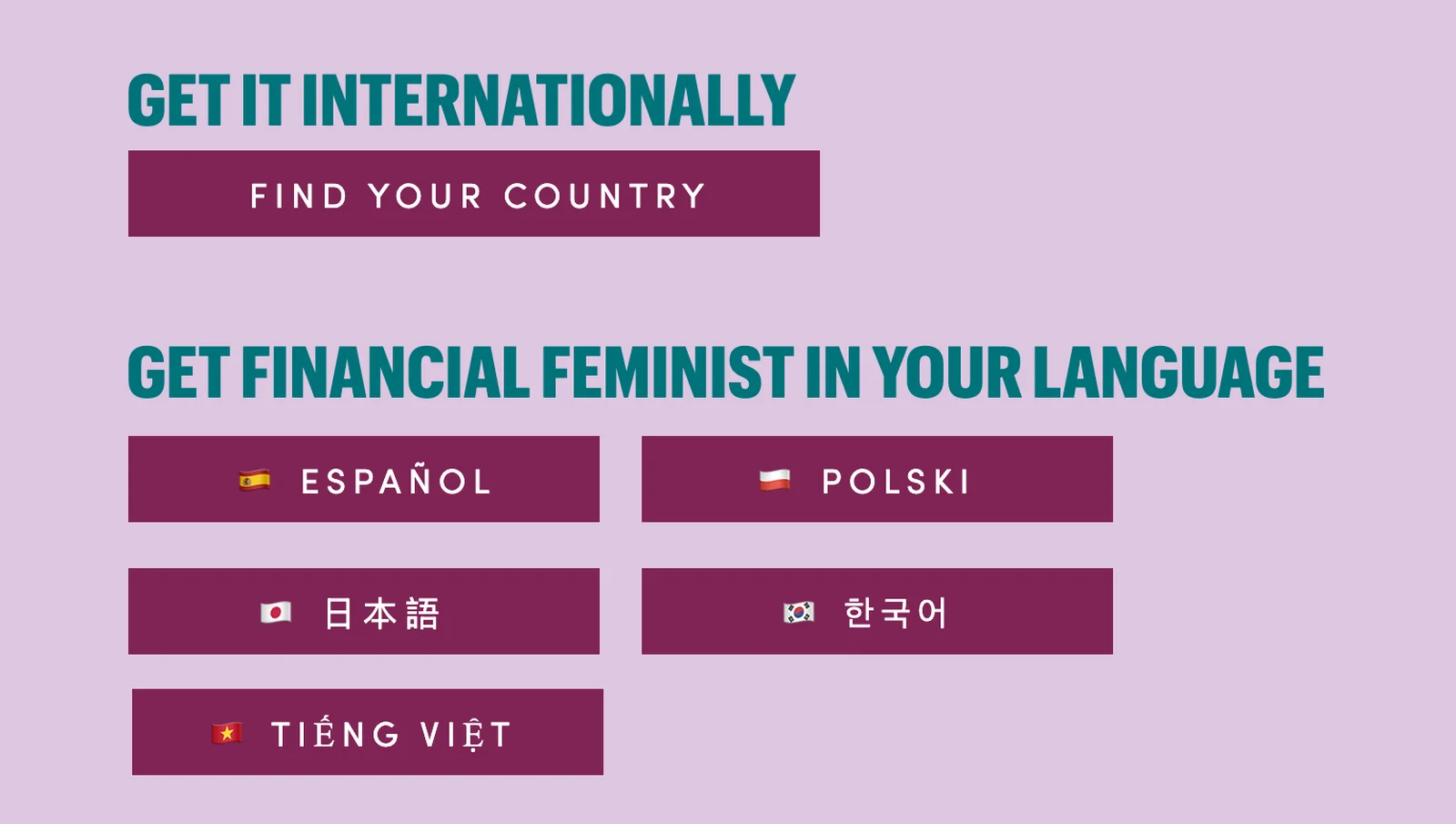
It invites listeners to grab my self-narrated audiobook. It lists editions in Español, Polski, 日本語, 한국어 and Tiếng Việt.
Her About page describes what came back: I got messages from thousands of women that you grabbed a copy from your neighborhood Target, listened to the audiobook on your hot girl walks, and put it on hold at your local library.
- 01Reading sectionsThe emotions of money, debt, earning.
- 02ExercisesInteractive, after each section.
- 03Journaling promptsTo help readers take action.
- 04Real storiesFrom former clients, now friends.
- 05AudiobookNarrated by Dunlap herself.
- 06Five translationsSpanish, Polish, Japanese, Korean, Vietnamese.
The community
Readers found each other. CNBC reported: A Facebook group named after the book has swelled to more than 100,000 members. In that group, members share financial wins and trade advice on topics like which banks or credit cards to use. Members have also organized virtual book clubs with others in the group to broaden their knowledge.
CNBC describes the loop: Women tap those resources to improve their financial lives, and then share the information with others.
She told CNBC why it works: People want to feel seen and they want to feel heard. This kind of identity-focused personal finance is one hundred percent necessary, and is the future of personal finance.
The free resources
Her site gives a lot away first. The free resources page says answering 6 questions could unlock your FREE, personalized financial game plan. After the quiz: You'll receive a list of hand-picked resources delivered directly to your inbox.
The page also offers 30 question cards to help spark fun, intimate, and beneficial conversations about money with your partner. A 5 day debt challenge promises: Get 5 days of actionable steps towards paying off your debt straight to your inbox! A 7 day savings sprint says: This is your chance to slow down, get honest about your money, and finally start building savings in a way that feels doable and sustainable.
Email is the prize. One of the signature talks on her Book me page covers how I used TikTok to get 100,000 email subscribers in ONE week.
- 01Money quizSix questions, then a game plan.
- 02Resource listHand-picked, sent to your inbox.
- 03Question cards30 cards for money talks with a partner.
- 04Debt challengeFive days of steps by email.
- 05Savings sprintSeven days to start saving.
- 06Email listA talk on 100,000 subscribers in one week.
The programs
The paid programs sit behind the free ones. Stock Market School says its goal is to transform you into a confident, educated stock market investor to financially protect yourself and your family.
The page lists what members get: Start with on-demand lessons that walk you through the basics, then bring your questions to live coaching with Team HFK. Take part in live monthly money dates, our signature self-care practice. Join a supportive community of like-minded investors who are learning and growing right beside you.
It lists a bonus: Be able to see Tori's investment strategy, including exactly what she invests in.
She explains the pitch: I don't believe in gatekeeping. Instead, I believe in providing financial education and accountability at an accessible price.
Her About page says: We created and launched our investing education platform, Stock Market School, with my friends Elias and Ivar (that has now helped over 15,000 women invest).
The $100K Club page opens: Get access to my proven no-shame money plan. The Quit page says: Join Tori Dunlap and Mallory Rowan for a 2-part workshop series that turns your "I want to quit someday" into a specific, executable path out.
She told Business Insider how she picks what to build: You need to get a low-cost MVP out there and test it, then iterate from there. For me, that MVP was my blog, and it's given me the opportunity to invest in many projects based on our community's interests.
- 01On-demand lessonsThe basics first.
- 02Live coachingQuestions answered by her team.
- 03Money datesLive and monthly.
- 04CommunityInvestors learning together.
- 05Her strategyWhat she invests in, as a bonus.
- 06ReachOver 15,000 women, by her account.
Working with brands
Her Book me page is written for sponsors. It says: For 5 years, I led marketing and growth for global brands.
It lists Workshops, Social media campaigns, Keynote speaker, Spokesperson, Event hosting or panel moderation and Custom content (videos, blog posts, etc.).
It makes a pitch about trust: 40% of young women say their favorite online influencer understands them better than their real-life friends. The page does not say where that figure comes from.
- 01WorkshopsTopics like budgeting and debt.
- 02Social media campaignsPosts on her channels.
- 03Keynote speakerHer signature talks.
- 04SpokespersonA voice for a brand.
- 05Event hostingOr panel moderation.
- 06Custom contentVideos, blog posts and more.
For how other money creators use short clips, read how finance creators grow with clipping.
The team
The company outgrew one person quickly. Entrepreneur reported in June 2021: In just over a year and a half, Dunlap's business went from being a solo project to having a team of eight.
Her About page now says: We've grown into a team of 15+ people that help to run HFK's operations so I can focus on what I really love.
The careers page says: We believe in practicing what we preach. It lists a 401(k) with a 4% company match and 4 months of fully paid parental leave.
Her money advice
Her advice starts with looking. She told TODAY: We call it the ostrich effect, people bury their head in the sand, and they act like their problems don't exist.
We call it paying yourself first, she told TODAY. You should be able to afford things that you want while saving, she said. So, if you tell somebody they can't spend money, that's not sustainable.
TODAY adds that she recommends narrowing it down to three value categories that are important to you, the things that are worth splurging on.
Fortune says: When Tori Dunlap asks women why they don't invest, their answer is almost always fear.
The rules for finance creators
A finance creator with sponsors carries duties. The FTC tells creators: If you endorse a product through social media, your endorsement message should make it obvious when you have a relationship (“material connection”) with the brand.
It gives a podcast example. Near the beginning of a podcast, the host reads what is obviously a commercial for a product. Even without a statement identifying the advertiser as a sponsor, listeners would likely still expect that the podcaster was compensated, so there is no need for a disclosure of payment for the commercial.
That covers an obvious host-read ad. Brokers that pay creators face their own rules. FINRA defines the term: “Social Media Influencers” or “Influencers” means any third party with whom the firm contracts or compensates to provide Social Media Communications.
See our guide to finfluencer marketing rules.
What any finance creator can copy
- 01Serve before you sellFree value first, then offers.
- 02Post every dayYears of daily posts before the break.
- 03Three jobs per videoEducate, inspire and entertain.
- 04Turn views into toolsA viral video became a free script.
- 05Go long when short runs outA podcast for depth.
- 06Own the listQuizzes and challenges that build email.
For the numbers behind the niche, read our finfluencer statistics. For other money creators, see our Vivian Tu breakdown, our Erika Kullberg breakdown and our Graham Stephan breakdown. For a finance creator who always writes in the first person to build trust, see our Martin Lewis breakdown. For a finance creator who wrote down a formula for what makes a video go viral, see our Sharan Hegde breakdown. For a finance creator who grew a women’s money community from a free email challenge, see our Tiffany Aliche breakdown. For a money brand for women that moved its writing from the website to the newsletter, see our The Financial Diet breakdown. For a creator who built a free credit card tool with no ads and no sponsorships, see our Ankur Warikoo breakdown. For a women and money podcast that answers listener questions twice a week, see our Suze Orman breakdown. For a finance brand whose fans call themselves Financial Mutants, see our Money Guy Show breakdown. For a finance creator whose daily show mixes money questions with mom life, home and reading, see our Rachel Cruze breakdown. For a finance brand whose annual conference welcomed over 700 in-person attendees in 2026, see our White Coat Investor breakdown. For a finance podcast that publishes its microphone, camera and lens list, see our Ben Felix breakdown. For a finance community that opened its own coworking headquarters in 2017, see our Mr. Money Mustache breakdown. For a FIRE community that holds meetups in Brooklyn and Porto, see our Our Rich Journey breakdown. For a money podcast that adds a free two-page download to each episode page, see our Afford Anything breakdown. For a finance site with over 10,000 approved comments, see our Mad Fientist breakdown. For a money creator who ran a 10-minute-a-day challenge, see our Budgets Are Sexy breakdown. For a finance blog where the comments are the community, see our Financial Samurai breakdown. For a finance brand for women whose founder writes 103 of its 304 posts, see our Clever Girl Finance breakdown.
We cut long-form finance videos and podcasts into daily short-form clips and post them on accounts you own, with disclosures in the video and every post tracked for views, link clicks and click-through rate. The system in this article, run for you.
Frequently asked questions
Tori Dunlap is the founder and CEO of Her First $100K, which Wikipedia describes as a financial education company aimed at young women. She started a financial education blog at 22 while working in digital marketing in Seattle, reached her savings goal in 2019 and went full time on the company that year. She hosts the Financial Feminist podcast and wrote the book of the same name.
By her account to Business Insider, organically. She reached 33,000 Instagram followers by posting every day for two or three years, and her following skyrocketed when she joined TikTok in 2020. She said she spent $20 on Facebook ads once and that everything else has been organic. Fortune reported two million TikTok followers in October 2022.
She told Entrepreneur that TikTok is great for virality and growing an audience, but that it is hard to have a nuanced conversation about money in 60 seconds. Financial Feminist launched on 17 May 2021, hit No. 1 on Apple Business charts within 72 hours and had been downloaded over a million times by late July 2021, Entrepreneur reported.
It is both her podcast and her book. The book came out with HarperCollins and became a New York Times bestseller. CNBC reported that it sold more than 150,000 copies in its first year in print. The Seattle Times describes reading sections followed by interactive exercises and journaling prompts.
Wikipedia says the company sells webinars and programs and produces a podcast. Its site lists Stock Market School, which mixes on-demand lessons with live coaching, the $100K Club and a workshop series called Quit. It also gives away a money quiz, question cards, a 5 day debt challenge and a 7 day savings sprint, and offers brands workshops, social media campaigns, speaking and custom content.
- Wikipedia: Tori Dunlap
- Her First $100K: About
- The Guardian: the TikTok feminist saving people from medical debt (Mar 2021)
- Entrepreneur: Tori Dunlap on the taboo topic of money (Jun 2021)
- Entrepreneur: the Financial Feminist podcast (Jul 2021)
- CNBC: where Tori Dunlap is investing (Nov 2021)
- The Cut: Tori Dunlap profile (Oct 2019)
- Good Morning America: how a 25-year-old saved over 100K (Oct 2019)
- Fortune: Tori Dunlap profile (Oct 2022)
- CNBC: Tori Dunlap and her community (Mar 2024)
- Business Insider: how to start a business with no money (Jan 2023)
- The Seattle Times: Tori Dunlap Q&A (Dec 2022)
- TODAY: value spending (Jun 2022)
- Her First $100K: Financial Feminist podcast
- Her First $100K: Financial Feminist book
- Her First $100K: Book me
- Her First $100K: Press
- Her First $100K: Free resources
- Her First $100K: Careers
- Her First $100K: Stock Market School
- Her First $100K: Quit Your Job in 90 Days
- Her First $100K: The $100K Club
- FTC: Disclosures 101 for Social Media Influencers (Wayback copy)
- eCFR: 16 CFR 255.5
- FINRA: Social media influencers sweep (Wayback copy)