Lido is the largest liquid staking protocol, with 23% of staked ETH in February 2026.
Its best marketing is integrations: stETH works as collateral across DeFi.
The DAO funds reach through grants and partner programs, and debates paid promotion in public.
Lido lets people stake ETH and get stETH back, a token they can still use. It launched in 2020 and is run by a DAO. This breakdown covers its scale, model, marketing, creators, regulators and social reach.
How big Lido is
Lido leads liquid staking, but its share is falling. In 2022: Slightly over 30% of all stake in Ethereum is staked using Lido.
In 2023 the press put it well below its current position at around 32% of the market. In 2024 it was controlling 28.75% of all staked ETH on Ethereum, according to Dune data.
By December 2025, Lido said it was representing nearly 25 per cent of all staked ETH with around 8.5 million ETH staked through the Lido protocol.
The homepage counts 700+ Operators across the globe using the Lido Protocol to run validators.
The DAO reports results. Staking generated a $6.73M operating result after all operational expenses, on $15.7M in revenue.
“The BlackRocks and Fidelities of the world are not going to log a ticket on Discord”Kean Gilbert, Lido institutional relations lead, to Blockworks
The model: stake, get a token, pay a fee
Users keep most of the yield. That means the users receive 90% of Ethereum staking rewards.
How the 10% splits depends on the source. The FAQ says: A 10% fee on staking rewards that is split equally between Node Operators and Lido DAO. DefiLlama says before V2 the split was a fixed 5%/5%, so half the fee is treasury. A 2026 update lists operator tiers: Standard at 3.50%, Extra Effort at 4.00%.
A court summarised it simply: the DAO keeps 5%, gives 5% to the validator, and gives the remaining 90% back to the users.
The token travels. stETH (and therefore wstETH) can be obtained not only via direct staking in Lido Core and wrapping, but also via Lido V3 stVaults. And stVaults (Staking Vaults) bring the benefits of Lido Core to fully custom staking setups.
Governance is part of the pitch. At launch, 36% of LDO are unlocked in the DAO treasury. Today, Dual Governance is Live on Ethereum mainnet since 4 July 2025, it lets stETH holders exit the protocol before potentially contentious proposals take effect.
The DAO take rate rose from 4.96% in December 2025 to 6.15% at the end of H1 2026. The same post also says 4.97% in December.
Marketing: integrations first
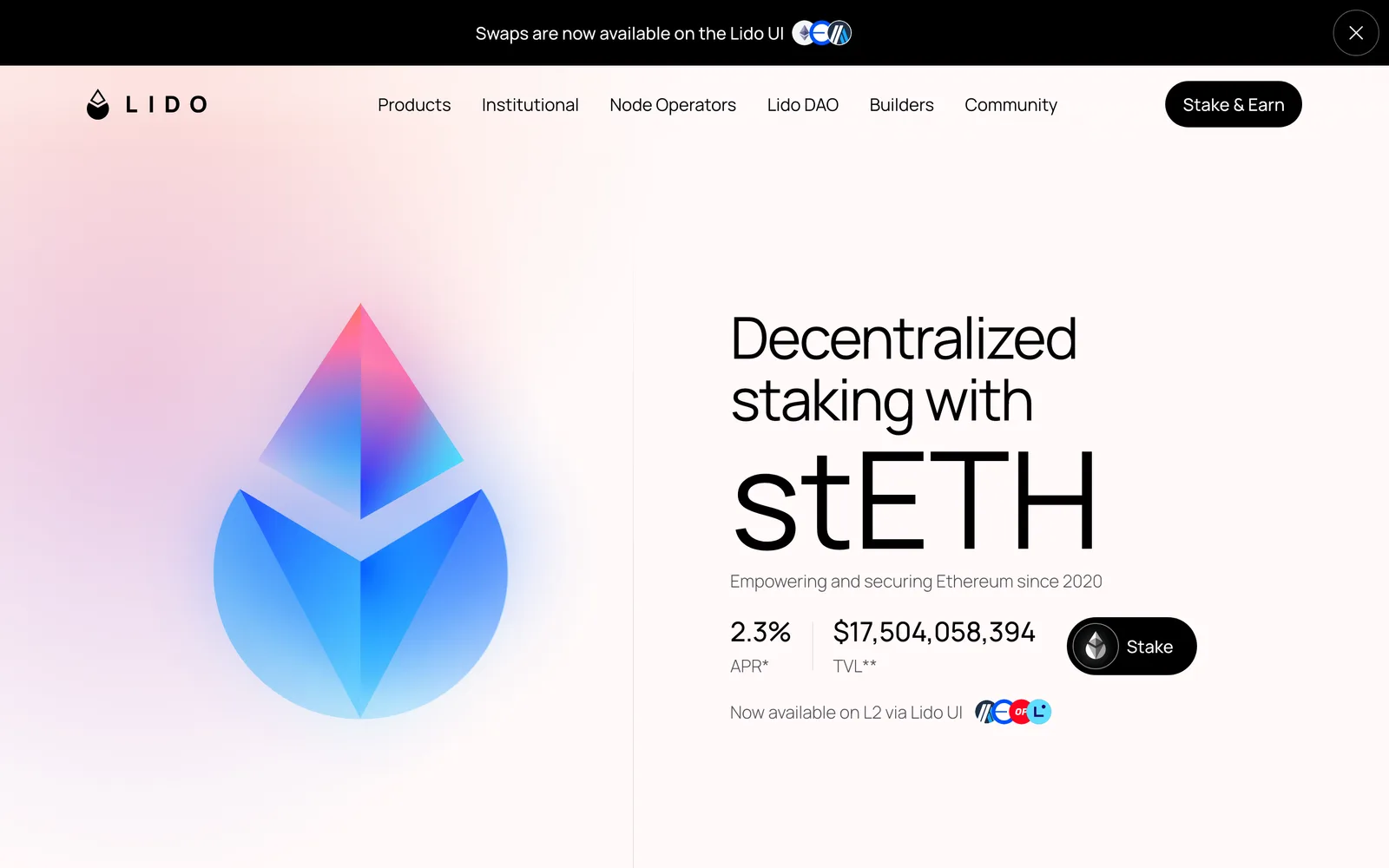
The homepage line is Empowering and securing Ethereum since 2020. It promises deepest liquidity and competitive rewards. It also sells safety: Over $4M invested in security, including audits, bug bounties, and expert reviews.
Integrations do the selling. Aave has integrated Lido’s stETH as a collateral asset on their platform. Early on, Curve Finance has a highly liquid stETH/ETH market.
The DAO paid for that liquidity. One proposal noted: This is in contrast to 4.8M LDO distributed to LPs in the previous period.
It spread across chains. The availability of wstETH to Base builds upon successful earlier launches across Arbitrum, Optimism, Polygon and Cosmos. With Chainlink CCIP, wstETH runs on each of the 16 chains.
Grants from other chains were contested. An Arbitrum grant passed with just 50.2% of votes cast in its favor.
New products bring new buyers. Lido V3 is live on Ethereum mainnet. An institutional lead said About 25% of Lido’s TVL today comes from institutional players, adding: The BlackRocks and Fidelities of the world are not going to log a ticket on Discord.
Wall Street wrappers followed. VanEck filed the ‘VanEck Lido Staked ETH ETF’. In Europe, LIST trades on Deutsche Börse Xetra, SIX Swiss Exchange and Euronext in Paris and Amsterdam.
Treasuries joined. Sharplink is deploying $200 million of its ETH treasury to staking through the Lido protocol.
Creators: grants, referrals and the KOL debate
Lido funds its community. LEGO funds individuals, projects, and initiatives that benefit the Lido protocol and the broader blockchain space. Grants can help raise awareness about Eth, PoS, DeFi.
Referrals came first. A 2021 post said: The reward program will serve as a marketing strategy to attract more people to use the protocol. They ended: To retire both the Solana and Ethereum referral programs on April 15th, 2023.
Now partners earn through Rewards Share, a program that helps spread awareness about liquid staking technology and liquid staking tokens like stETH.
Paid promotion is debated in public. One member wrote: I am requesting a $9,000 marketing budget for Chinese KOL promotion. The same post listed Total Budget : $9,500.
Another replied that they don’t believe Lido needs to use inorganic methods of marketing for Lido V3.
Grants also fund education, such as Creating Spanish explainer videos about Lido and translation of Lido Help Center. Hackathons help too: the 3000 LDO prize goes to Tom!
For the method, read how to market a crypto project.
- 01LEGO grantsFund people, projects and initiatives, including awareness of Eth, PoS and DeFi.
- 02ReferralsA 2021 marketing strategy. Retired on 15 April 2023.
- 03Rewards SharePartners earn for spreading awareness of liquid staking and stETH.
- 04KOL requestA member asked for $9,000 for Chinese KOL promotion, $9,500 in total.
- 05PushbackAnother member doubted Lido needs inorganic marketing for Lido V3.
Regulators and the Samuels lawsuit
In 2025, SEC staff said liquid staking activities as described do not involve the offer and sale of securities within the meaning of Section 2(a)(1) of the Securities Act of 1933 That is a staff view, not a rule.
One commissioner dissented: Caveat liquid staker.
Lido added its own analysis: Accordingly, Lido protocol’s activities do not involve the offer or sale of securities.
A token buyer sued. The court said he has alleged that Lido is a general partnership within the meaning of California law. That is an allegation.
He also claimed Lido promoted the new listings in public posts on Discord (a messaging and social platform) and on Lido’s official Twitter account. The defendants replied: The defendants argue that Lido DAO could not have solicited Samuels’s purchase because he does not specifically allege that he saw any of Lido DAO’s promotional social media posts.
At the pleading stage, the court found Samuels has adequately alleged that Lido indeed solicited the purchase of these tokens on crypto exchanges. It ruled Samuels has adequately alleged that all the investors except Robot Ventures are general partners. All other motions to dismiss are denied.
Later: The motion to certify an interlocutory appeal is denied.
Paid creators must disclose. The FTC Endorsement Guides say such connection must be disclosed clearly and conspicuously. Material connections can include a business, family, or personal relationship. They can include monetary payment or the provision of free or discounted products. See our guide to crypto influencer marketing.
Social accounts
On 18 November 2026, raw X data read "followers":227304. Discord showed "approximate_member_count":31983. Telegram showed 8 379 members.
YouTube data read "content":"14.5k subscribers". A LinkedIn snapshot showed 6,300 followers.
What any crypto project can copy
- 01Be the default assetstETH wins because so much DeFi accepts it.
- 02Integrate everywherewstETH runs on 16 chains through one standard.
- 03Sell securityAudits and bug bounties are on the homepage.
- 04Fund community contentGrants pay for explainers and translations.
- 05Court institutionsETFs and treasuries need a different pitch than Discord.
- 06Disclose every partnershipThe FTC needs clear notice of a material connection.
For the numbers, read our crypto marketing statistics. For a DeFi protocol that accepts stETH, see our Aave breakdown. For a DAO that ended its working groups, see our Jupiter breakdown. For a yield token marketed through airdrops, see our Ethena breakdown. For the oracle network whose cross-chain tool Lido upgraded to, see our Chainlink breakdown. For a crypto brand that runs a press and brand center with a short boilerplate, see our Gnosis breakdown. For a crypto media brand that sends Ethereum Weekly every Saturday morning, see our Bankless breakdown. For a tenth birthday marked by 100+ community-led events on 6 continents, see our Ethereum breakdown. For a blockchain blog where 151 posts link to the docs, see our Sui breakdown. For a crypto product launch told in five posts in two weeks, see our Uphold breakdown.
We edit and post every day on accounts you own, with disclosures in the video and every post tracked for views, link clicks and click-through rate.
Frequently asked questions
Lido said it held 23% of staked ETH in February 2026, down from slightly over 30% in 2022. It lists 700+ node operators.
It takes a 10% fee on staking rewards, so users get 90%. The fee is shared between node operators and the Lido DAO.
Mostly through integrations: Aave collateral, Curve liquidity, wstETH on 16 chains, institutional products and ETF filings.
It funds grants that can pay for awareness content and runs a partner rewards program. A 2025 request for paid KOL promotion drew pushback on its forum.
Be the default asset, integrate everywhere, sell security, fund community content, court institutions and disclose every paid partnership.
- Scale: Lido TVL on 1 Jan 2022 was about $11.93B (DefiLlama daily series)
- Scale: about 635K unique stETH holders (proxy for stakers)
- Scale: in May 2022 Lido had slightly over 30% of all staked ETH
- Scale: about 32% of staked ETH in Sep 2023
- Scale: 28.75% of staked ETH in Aug 2024
- Scale: nearly 25% of staked ETH and about 8.5M ETH in Dec 2025
- Scale: market share 23% in Feb 2026, still the largest staking protocol
- Scale: 700+ node operators use the protocol
- Scale: about $3.45B all-time staking rewards (fees) generated
- Scale: H1 2026 DAO revenue $15.9M net; staking operating result $6.73M
- Model: 10% fee on staking rewards, users get 90%
- Model: DefiLlama says the split was a fixed 5%/5% only before V2
- Model: court summary of the fee: DAO keeps 5%, validator 5%, users 90%
- Model: wstETH is the wrapped version of stETH used in DeFi
- Model: stVaults bring Lido Core to custom staking setups (Lido V3)
- Model: LDO launched with 36% held in the DAO treasury
- Model: Dual Governance live since 4 July 2025 lets stETH holders exit before contentious proposals
- Marketing: Aave added stETH as collateral in 2022
- Marketing: Curve stETH/ETH pool is the main liquidity venue
- Marketing: LDO liquidity incentives for Curve, 3.75M LDO for 30 days in 2021
- Marketing: wstETH expanded to Base after Arbitrum, Optimism, Polygon and Cosmos
- Marketing: Chainlink CCIP chosen as wstETH cross chain standard on 16 chains
- Marketing: Arbitrum DAO grant to Lido passed narrowly
- Marketing: Lido V3 with stVaults went live Jan 2026
- Marketing: VanEck filed a Lido Staked ETH ETF
- Marketing: Sharplink put $200M of its ETH treasury into Lido
- Creators: LEGO grants fund people and projects that help Lido
- Creators: referral rewards framed as a marketing strategy
- Creators: Ethereum and Solana referral programs retired April 2023
- Creators: Rewards Share program pays partners to spread stETH
- Creators: community member asked $9,000 for Chinese KOL promotion of V3
- Creators: Spanish explainer videos grant (Cryptoversidad)
- Creators: 2021 Open DeFi hackathon prize in LDO
- Regulation: outcome, SEC staff say liquid staking as described is not a securities offer
- Regulation: Commissioner Crenshaw dissented
- Regulation: Lido response, its activities are not securities offers
- Regulation: outcome, interlocutory appeal denied Feb 2025
- FTC 16 CFR 255.5: unexpected material connections must be disclosed clearly and conspicuously
- Social: X @LidoFinance about 227K followers
- Social: Discord about 32K members
- Social: Telegram main group about 8.4K members
- Social: YouTube @LidoFinance 14.5K subscribers
- Social: LinkedIn about 6,300 followers